
True Damage is still Ekko’s best skin
Ekko skins do not get one reveal. They get two. Timewinder has to look convincing on the way out and on the way back. Chronobreak has to make the afterimage worth tracking before the rewind earns its explosion. Even his basic trading pattern saves the loudest visual beat for the third Z-Drive Resonance proc. A skin can look excellent in a still image and still lose its identity halfway through that loop.
True Damage Ekko is the best Ekko skin overall. It gives his repeated actions the strongest rhythm, replaces enough animation and voice work to justify its Legendary tier, and makes the third hit, W activation, and ultimate feel like parts of one music-driven system. Arcane Last Stand is the better recommendation at 1,350 RP when it is obtainable. Sandstorm is the best lower-price option. Breakout True Damage has some of the catalog’s best effects, but its rare access prevents it from beating the original as a purchase.
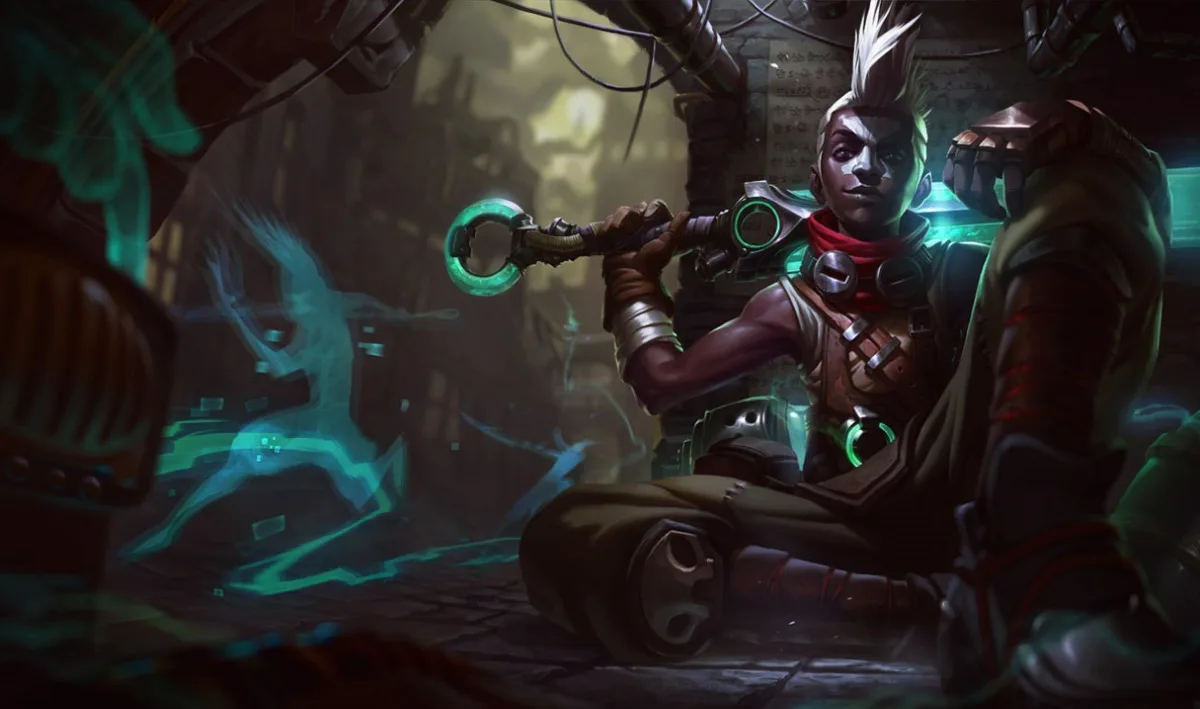
Base Ekko is the control sample for every review. His blue-green time effects, readable afterimage, strong silhouette, and excellent movement still give lower-price skins a difficult standard to beat. Image: Riot Games.
Reviewed for Patch 26.17 on August 31, 2026. Riot’s Data Dragon 16.17.1 catalog contains 59 Ekko cosmetic records: one base entry, 12 non-base parent skins, and 46 chroma children. This article ranks the 12 parent skins, not each color variant. Prices and rotating access can change, so confirm the live client before spending RP, Mythic Essence, Ancient Sparks, or event currency.
Every Ekko skin, ranked
This is an editorial ranking, not a claim that a cosmetic changes damage, range, hitboxes, stun duration, invulnerability, or any other rule. A cleaner effect can be easier for one player to parse and noisier for another. None of that makes a skin pay to win.
| Rank | Skin | Price or access record | The deciding moment |
|---|---|---|---|
| 1 | True Damage Ekko | 1,820 RP | The third proc, movement, voice, music, and rewind all share one rhythm |
| 2 | Arcane Last Stand Ekko | 1,350 RP, Legacy | The best modern W field and a superb blue-purple Chronobreak |
| 3 | Arcane Firelight Ekko | 1,350 RP, check live client | A faithful model, distinctive homeguard, and coherent green-gold spell set |
| 4 | Breakout True Damage Ekko | Rare Mythic Variant | Brilliant piano details trapped behind the catalog’s hardest value argument |
| 5 | Trick or Treat Ekko | 1,350 RP, Legacy | The pumpkin Timewinder and ghostly rewind commit to one playful idea |
| 6 | Pulsefire Ekko | 1,350 RP | Precise clock geometry makes the two-way spell kit easy to follow |
| 7 | Sandstorm Ekko | 975 RP | The best inexpensive transformation, with a theme that naturally fits time magic |
| 8 | PROJECT: Ekko | 1,350 RP | Strong wireframe effects, but a 2016 digital treatment now shows its age |
| 9 | Prestige Star Guardian Ekko | Rare, rotating Mythic access | Cleaner spell hierarchy than the standard version, with a weak access-to-change ratio |
| 10 | SKT T1 Ekko | 1,350 RP, Legacy | A sharp championship tribute whose best moments sit outside the core spell loop |
| 11 | Star Guardian Ekko | 1,350 RP | Ambitious effects lose some of Ekko’s physical snap and visual attitude |
| 12 | Academy Ekko | 750 RP | A fun model swap that asks base Ekko to supply almost everything felt in combat |
The access labels above are a snapshot, not a store promise. Legacy skins can return through limited windows, Your Shop, loot, or other promotions. Prestige and Mythic Variant routes are even less stable. A skin sitting higher in this list can still be the wrong purchase if the only available path is expensive or uncertain.
The rewind test behind the ranking
Ekko creates a special problem for skin reviews because so much of his presentation is deferred. The first hit is setup. Q’s first trip is only half the projectile. W spends several seconds hidden before its field becomes relevant. R advertises a future landing point with an afterimage, then pays that promise off in reverse. The ranking therefore follows a full sequence rather than awarding points for one dramatic ultimate frame.
- Z-Drive Resonance: The first two marks need to stay legible without stealing attention from the third-hit burst and movement-speed payoff.
- Timewinder: The outward throw, expansion, turn, and return path need a coherent shape. A beautiful outward disc is not enough if the returning projectile becomes mush.
- Parallel Convergence: The delayed field, slow area, Ekko’s entry, shield, and stun moment must feel related. This is where overloaded skins often confuse anticipation with payoff.
- Phase Dive: The roll, blink, and empowered attack should land as one quick acceleration, not three disconnected flashes.
- Chronobreak: The afterimage must establish a convincing earlier Ekko. The rewind trail and arrival explosion then have to justify watching that ghost for several seconds.
- Repeated audio: Q and basic attacks happen too often for a sharp electronic chirp, bell, or musical cue to survive on novelty alone.
- Model and recall: Silhouette, weapon shape, movement, voice, homeguard, and recall count, but they cannot hide a weak in-combat package.
- Value and access: A 750 RP model swap has a different burden of proof from a Legendary, Prestige, or Mythic Variant skin.
Base Ekko remains a serious control sample. His default bat-like weapon reads at a glance, his cyan effects separate setup from detonation, and his Chronobreak ghost stays recognizable in a crowded fight. A paid skin has to offer more than a different jacket.
12. Academy Ekko is a costume, not a new timeline

Academy gives Ekko a mischievous school-uniform model and a strong character joke, but its combat still depends on the base skin’s effects and animation language. Image: Riot Games.
Academy Ekko gets the character immediately. He is the student who could ace the exam, skip the class, re-run the afternoon, and still end up in the dean’s office because he dismantled school electronics on the way out. The loosened uniform, oversized weapon, and troublemaker posture make a clean 750 RP model concept.
Then lane starts, and the joke mostly stops moving. Academy uses the base combat language for the parts that matter most: the marks, Timewinder, Parallel Convergence, Phase Dive, and Chronobreak. Base Ekko carries that workload well, so the skin is not ugly or difficult to use. It is simply the only parent in the catalog that gives the rewind test almost no new answer.
That limitation is most obvious on R. The school model disappears into the same familiar afterimage and returns through the same familiar explosion. There is no detention stamp, chemistry accident, broken clock, or rebellious piece of Academy iconography tying the premise to the rewind. The recall does not create the kind of final character beat that could compensate for that absence either.
At 750 RP, expecting a full VFX rebuild would be unreasonable. The price is also why Academy avoids harsher criticism. Buy it if the uniform is the exact model you want and you already prefer base Ekko’s effects. Do not buy it expecting a new version of how Ekko’s kit feels.
11. Star Guardian Ekko reaches for too many stars

Star Guardian builds a complete magical-hero spell package around Ekko, but its bright palette and softer shapes weaken some of the sharp physical rhythm that defines his best skins. Image: Riot Games.
Star Guardian Ekko is not low because Riot failed to make things. It is low because the many attractive pieces never settle into Ekko’s strongest cadence.
The skin changes his model, recall, homeguard, familiar-driven details, and full spell palette. Timewinder becomes a bright magical projectile with orange, blue, and violet accents. Parallel Convergence blooms as a translucent cosmic dome. The ultimate brings the familiar and the Star Guardian sparkle language into a large, colorful arrival. Measured as a checklist, it comfortably clears the Epic tier.
Measured at Ekko speed, it is less convincing. His best skins give the Q return a decisive snap and let the third passive hit act as punctuation. Star Guardian rounds those beats into soft magical shapes. The W field is pretty while waiting, but the center, outer dome, familiar, stars, and color transitions all compete for the same second of attention. Phase Dive wants to feel like a kid suddenly breaking the distance; here it can feel like another effect entering an already crowded sentence.
The model has a related problem. The orange weapon and bright uniform can read more like a transformed magical prop than something Ekko built, broke, and rebuilt himself. That interpretation is valid for the universe, yet it leaves less of the Zaunite inventor’s scrappy physicality than True Damage, Firelight, or even Sandstorm.
Players who love the Star Guardian roster may reasonably reverse this placement. The skin is colorful, complete, and supported by nine chroma records. For an Ekko-first buyer judging the repeated combat loop, however, it is one of the few 1,350 RP choices where the extra spectacle dilutes the champion rather than sharpening him.
10. SKT T1 Ekko saves its best scene for the ceremony
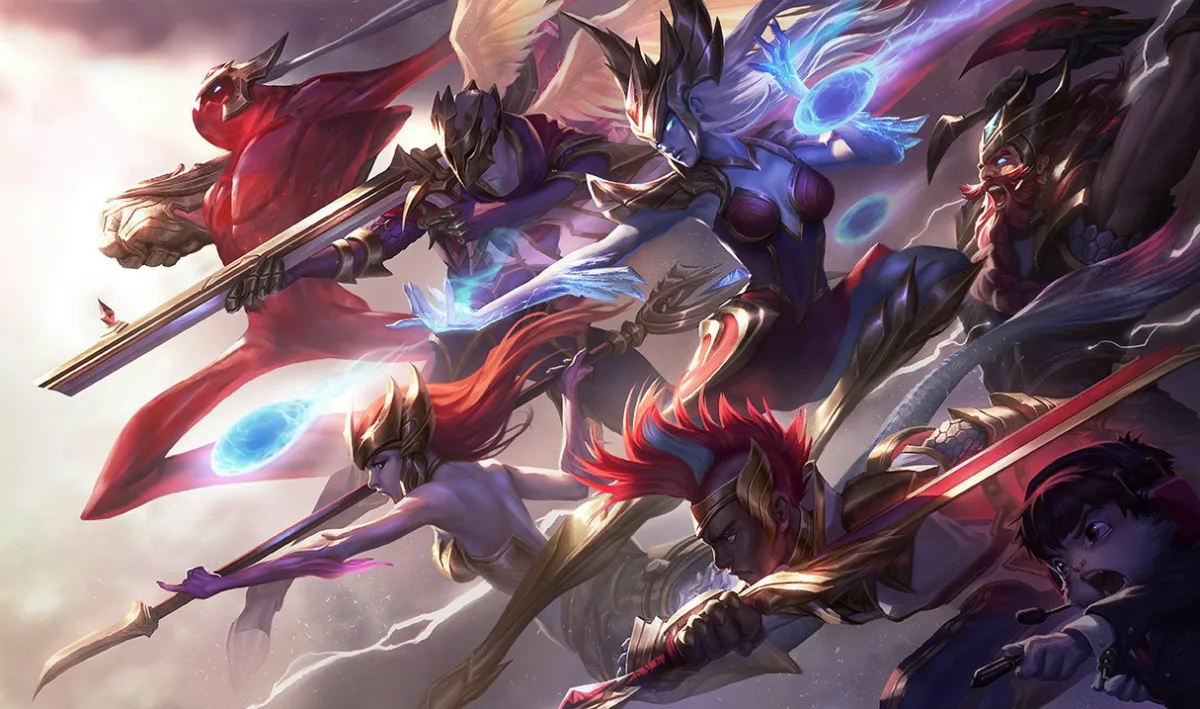
SKT T1 Ekko is a polished tribute to Duke’s 2016 world championship performance, with a red-black model, gold details, team effects, and a celebratory recall. Image: Riot Games.
SKT T1 Ekko works best as a record of a specific championship, not as the final answer to Ekko’s cosmetic potential. Riot created it to honor Duke’s winning performance during the 2016 World Championship, and the skin’s strongest material is appropriately ceremonial. The team colors, trophy language, signature, and recall have meaning that a generic red-and-gold skin would not.
In ordinary combat, that history has to share space with a comparatively restrained effect set. The red model is easy to identify and the gold circles give proc and spell moments a clean competitive finish. Parallel Convergence can look handsome when its team-branded geometry settles over the ground. The trouble is that Timewinder and Phase Dive do not establish a distinctive physical idea beyond the palette. The third hit flashes as a branded success state, but it does not transform Ekko’s repeated rhythm the way True Damage’s music or Trick or Treat’s Halloween props do.
Chronobreak tells the same story. The gold-edged return has a satisfying victory color, yet the afterimage and explosion feel like an esports finish applied to Ekko rather than a new theory of time. That is not a flaw in the tribute. It is why the tribute lands tenth in an all-skins comparison.
The 1,350 RP price also meets Legacy access. That combination makes SKT T1 sensible for collectors, fans of the 2016 roster, and players who want a relatively light effect set. If you do not care about the championship context, Sandstorm delivers a more champion-specific transformation for less RP whenever both are available.
9. Prestige Star Guardian fixes color, not the premise

Prestige Star Guardian replaces the standard skin’s orange-heavy palette with white, purple, teal, and crystalline effects, producing a cleaner but still familiar version of the same spell package. Image: Riot Games.
Prestige Star Guardian Ekko is the better of the two Star Guardian parents. The white, purple, teal, and restrained gold palette creates stronger separation between model and spell. Timewinder’s rotating core is easier to appreciate without the standard version’s orange-heavy color contest. Parallel Convergence has a clean star at its center, then turns its shield and stun into a bright crystalline payoff. Chronobreak’s turquoise-white burst looks like a single event instead of several magical motifs arriving together.
The streetwear model also fits Ekko better than the standard transformation. It keeps the fashion-forward Star Guardian universe while returning some weight to his weapon and posture. The result feels closer to a young inventor who happens to be styled for an event, not a magical hero costume looking for the champion underneath it.
Why only ninth? Prestige changes do not create a new animation set or voice. The core movement and spell sequencing remain attached to the standard parent. Once the palette correction has been absorbed, the same soft attack rhythm and familiar-driven magic still sit underneath. This is a refinement, not a reinvention.
Access raises the standard further. The current catalog treats Prestige Star Guardian as rare, and Riot has rotated it through the Mythic Shop in the past. A historical 150 Mythic Essence appearance does not guarantee that price or availability today. When a skin asks for rotating currency and patience, a cleaner color hierarchy is not enough to beat several fixed-price skins with more distinct Ekko ideas.
Choose Prestige over standard Star Guardian if you already love this universe and prefer the cooler palette. If the choice is between waiting for Prestige and buying a strong everyday Ekko skin, True Damage, Pulsefire, and Sandstorm offer clearer value propositions.
8. PROJECT: Ekko is a good blueprint with old hardware

PROJECT turns Ekko’s temporal tools into green holographic schematics and code, an effective 2016 concept that now competes with newer technological skins. Image: Riot Games.
PROJECT understands one important thing that some newer skins miss: Ekko’s spells are plans becoming real. Green wireframes sketch the route before the hit. Holographic duplicates mark past movement. Parallel Convergence draws a technical field that looks calculated rather than summoned. When Chronobreak closes, the skin turns an abstract rewind into a system restoring an earlier state.
That is excellent thematic logic. It also produces several of the catalog’s most readable sequences. The outward and returning Timewinder use the same neon-green construction language, so the second pass does not become an unrelated projectile. W’s rings and grid establish a location without burying its center. Phase Dive looks like a corrupted frame being skipped, which suits both the animation and the PROJECT fiction.
The age shows in the finish. PROJECT arrived in 2016, and its green digital filter now has to compete with Pulsefire’s cleaner clock faces, True Damage’s animation work, and Arcane Last Stand’s modern gradients. The model’s dark armor and bright accents remain striking, but the color can flatten into a single green mass when passive marks, Q, W, an afterimage, and an enemy effect overlap. The filtered audio also repeats a narrow electronic texture across attacks that Ekko performs constantly.
This is still a respectable 1,350 RP skin. In fact, players who prefer hard cyberpunk to polished time-police aesthetics may place it above Pulsefire. The ranking gap comes from refinement, not concept. PROJECT wrote a very good blueprint; later skins manufactured cleaner parts.
7. Sandstorm Ekko is the best cheap skin by a mile
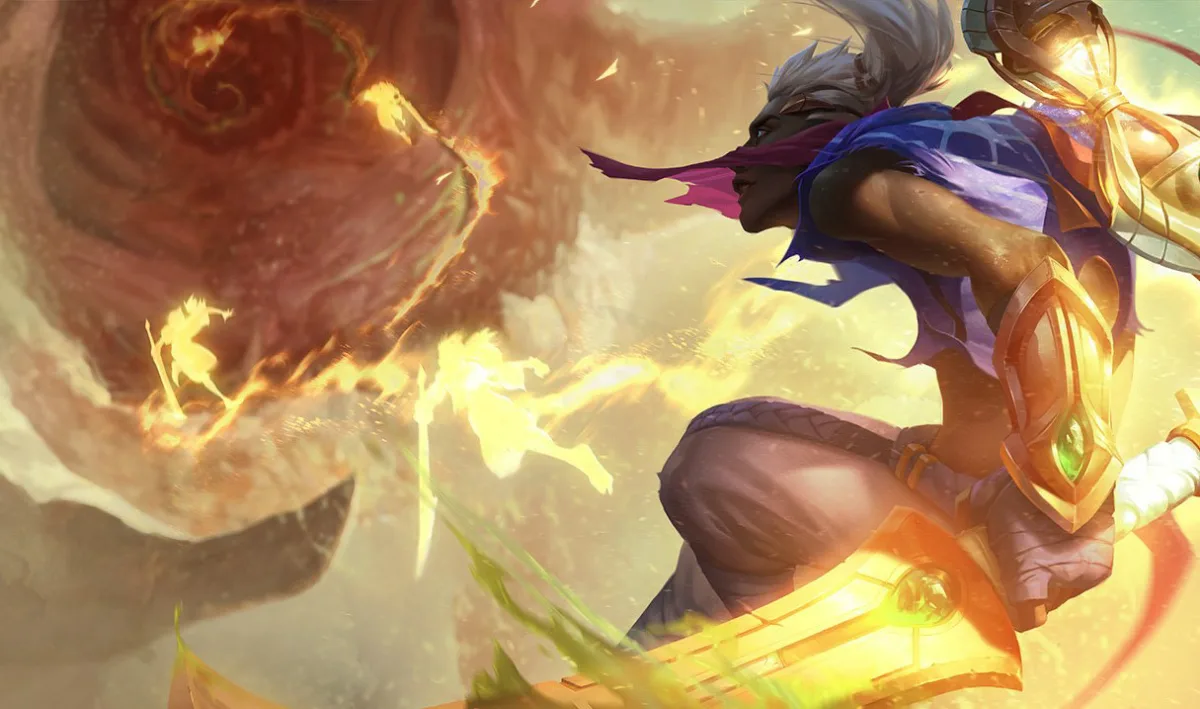
Sandstorm turns Ekko into a desert time raider and uses gold, turquoise, and ancient clockwork shapes to make a complete 975 RP package. Image: Riot Games.
Sandstorm is the catalog’s best argument against judging a skin by tier. It launched alongside Ekko, costs 975 RP in the current secondary catalog record, and still finds a champion-specific reason for almost every change.
Time and buried civilizations already belong together. The model turns Ekko into a desert raider carrying a curved, relic-like weapon. Gold trails and turquoise accents make Timewinder feel like a device recovered from a ruin. Parallel Convergence resembles an ancient seal being activated under an enemy rather than a generic colored circle. The third passive hit arrives in a clean burst of gold, then lets Ekko’s movement do the rest.
The best detail is restraint. Sandstorm does not try to outshine every later Epic. Its Timewinder remains compact enough to follow on both legs. Its W uses ornamental geometry without filling the entire dome with particles. Chronobreak’s gold arrival reads as the release of stored time, even though the animation budget is plainly older and smaller than True Damage’s or Last Stand’s.
Some of the audio and animation inherit base Ekko’s age, and the model cannot match the cloth, hair, and movement detail of recent Arcane skins. Seven chroma children offer color options, but chromas do not modernize those shared bones. None of that changes the purchase recommendation. If you want a genuine alternate timeline below 1,000 RP, Sandstorm is the clear choice. Academy changes the outfit. Sandstorm changes the fiction.
6. Pulsefire Ekko makes time literal

Pulsefire gives every delayed spell a clock face, holographic trail, or measured ring, making it the most literal time-engineering skin in Ekko’s catalog. Image: Riot Games.
Pulsefire does not search for a metaphor. It puts clocks on the floor.
That blunt approach works surprisingly well for Ekko. Timewinder becomes a compact blue-white device whose outward path, expansion, and return all resemble phases of the same calibrated tool. Parallel Convergence lays down measured circles and a central temporal mechanism. The shield locks around Ekko like a completed calculation. His afterimage is an obvious holographic copy, and Chronobreak collapses the stored route through blue and orange clockwork rather than an undefined energy blast.
The skin is particularly good when abilities overlap. Q remains a solid object while W is mostly planar geometry. The afterimage is humanoid and luminous. The arrival explosion is large, but it uses a different internal pattern from the waiting field. Those choices help each delayed event retain its own job. Again, that is an aesthetic observation, not a promise of competitive advantage.
Pulsefire loses ground through repetition. The clock motif appears on the passive, W, recall, and ultimate so consistently that surprise disappears. Its synthetic attack sounds are tidy at first and sterile after several waves. The white-haired armored model is well made, yet it belongs to a crowded technological skin line and says less about Ekko’s own hand-built ingenuity than PROJECT’s hacker framing or Firelight’s Zaunite equipment.
At 1,350 RP with seven chroma children, Pulsefire is the safest ordinary Epic for players who want disciplined effects and no voice replacement. It is less expressive than the five skins above it, but more internally controlled than almost everything below.
5. Trick or Treat Ekko turns every return into a punchline
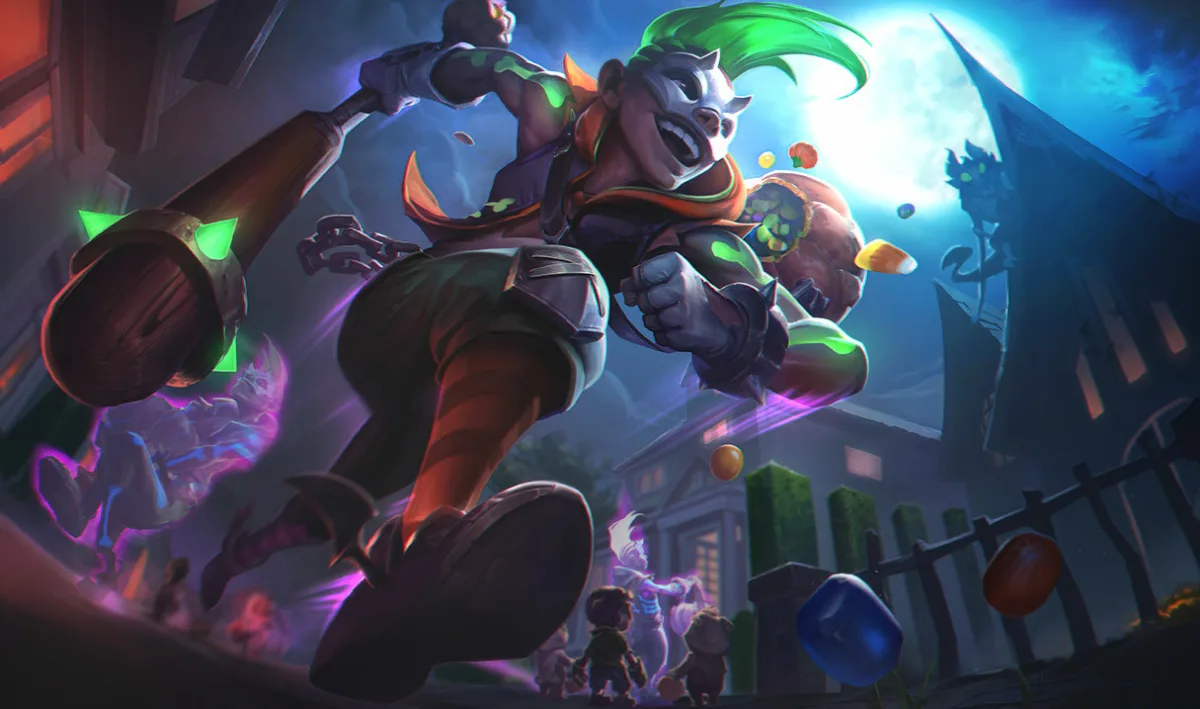
Trick or Treat gives Timewinder a pumpkin identity, fills W and R with playful purple haunting effects, and turns Ekko’s delayed kit into a Halloween setup and payoff. Image: Riot Games.
The obvious joke is good: Ekko can rewind the night and collect the same candy again. The better joke happens in combat, where every delayed spell behaves like a Halloween setup waiting for its scare.
Timewinder carries the pumpkin idea through both directions. It is not merely an orange projectile on the first throw. The object expands into a round, carved threat, hangs for its beat, and comes back through the same purple-orange language. Parallel Convergence looks like a haunted bubble being prepared around its victim. When Ekko enters, the shield and stun make the field feel sprung rather than simply activated.
Chronobreak is where the premise earns fifth place. A ghostly trail follows Ekko’s movement, and the return converts that stored haunting into a bright purple impact. The effect is comic without becoming weightless. Phase Dive still reads as a quick physical hit because the skin reserves the biggest supernatural shapes for W and R.
The skin also survives repetition better than expected. Pumpkin and candy details are recognizable, but the ordinary attacks do not play a full novelty routine on every swing. That restraint protects the joke across a long game. The recall supplies the theatrical Halloween scene when the player actually has time to watch it.
Trick or Treat is Legacy, which complicates a normal 1,350 RP recommendation. It also has six chroma children, including historically restricted variants. Check the live client rather than trusting an old event guide. If the parent returns and you want one playful Ekko skin, this is the best complete theme outside True Damage. It understands that a rewind can be a punchline as well as a rescue.
4. Breakout True Damage looks expensive because it was
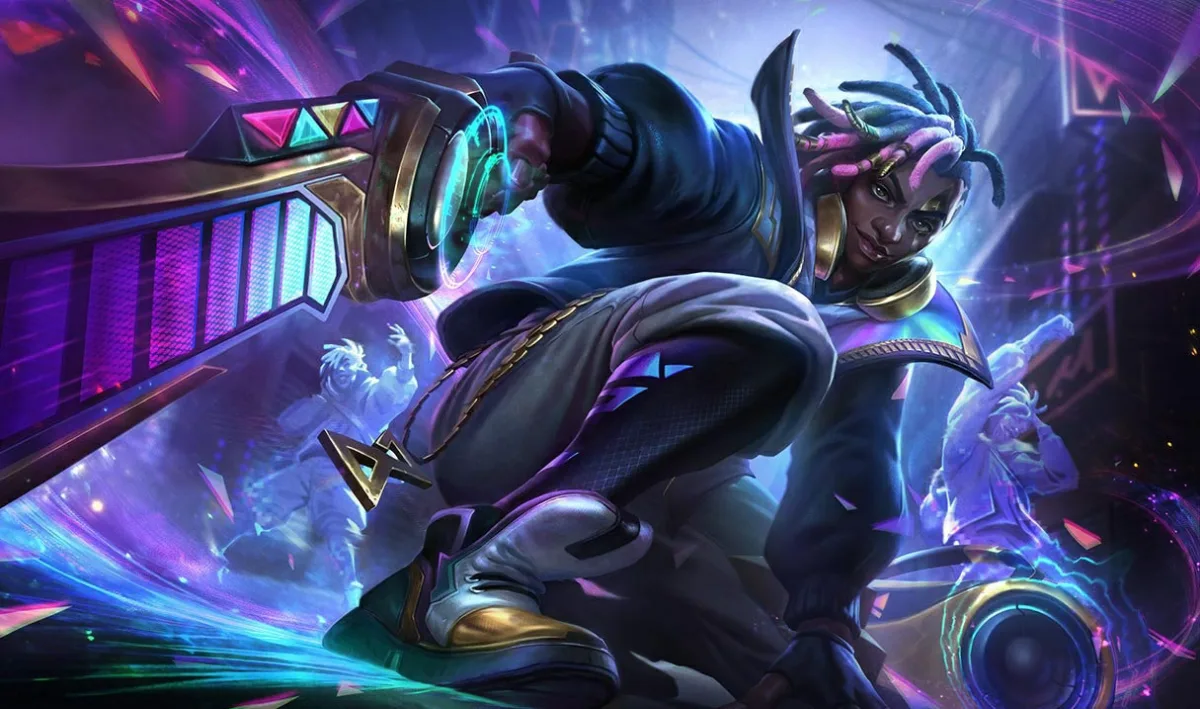
Breakout reshapes True Damage around hip-hop piano, adding keyboard details, a weapon visualizer, changed Q and W elements, a piano-stair recall, and altered music cues. Image: Riot Games.
Breakout True Damage is not an ordinary chroma. Data Dragon lists it as its own non-base parent record, and Riot called it a Mythic Variant. Riot also documented the actual work: an animated weapon visualizer, a recolored model and VFX, changed Q and W elements, piano-key recall stairs, and additional hip-hop piano audio.
Those changes are visible in the loop. The weapon carries a moving equalizer-like display. Timewinder’s face becomes a cleaner music dial, with piano and visualizer shapes traveling through the outward and returning passes. W replaces the original’s darker vinyl-club center with a more open circular composition of notes, bars, and keyboard color. When the field activates, the graphic closes like a beat resolving. Chronobreak preserves the Legendary parent’s animation quality while shifting the explosion toward white, teal, and pink geometric shards.
In pure presentation, Breakout competes for second place. The black-and-white model is excellent, the piano concept is specific, and the altered music gives familiar animations a genuinely different tempo. It is more than a red tint placed over a premium skin.
It still ranks fourth because value is part of this review. Breakout launched through a capsule milestone rather than a fixed RP purchase, and Riot later brought it to the Sanctum under the current Mythic Variant system. The secondary catalog now records a rare, pull-based route rather than ordinary store access. Exact featured banners and costs can change; none should be assumed live from historical notes.
That access burden matters because True Damage Ekko already supplies the full Legendary animation set, new voice, music, and eight chroma children at a fixed 1,820 RP when available normally. Breakout is a superb variant for a collector who already values its piano direction. It is a poor reason for an ordinary buyer to chase a randomized or capped-pull system. Great art does not erase the way it is sold.
3. Arcane Firelight Ekko brings the hoverboard home

Arcane Firelight adapts Ekko’s masked leader look, hoverboard homeguard, green-gold technology, and Firelight symbols into a coherent Epic package. Image: Riot Games.
Arcane Firelight starts winning before the first camp or minion wave. Its hoverboard homeguard is one of the few out-of-combat additions in Ekko’s catalog that changes how the champion enters the map rather than merely giving him another pose. The mask, jacket, weapon, and green chem-light details then carry the screen identity established by Arcane into League’s older animation frame.
The spell package avoids becoming a costume tie-in. Timewinder is edged in green and warm gold, with a solid device at its center. That warmth matters on the return, where the projectile remains distinct from the green trail. Parallel Convergence uses a large Firelight-flavored field with symbols around the perimeter and a brighter central activation. Its shield feels improvised and energetic, not like generic Arcane magic.
Phase Dive benefits from the model. The lean clothing and long weapon preserve Ekko’s low, forward movement, so the empowered hit feels like a street fighter closing distance. Chronobreak trails a green version of the Firelight palette, then releases a luminous circular burst with a crisp symbol at the center. It is not the catalog’s largest R, and that is a strength during a sequence already carrying Q, W, and passive marks.
Firelight misses second for two reasons. First, it keeps the base voice and much of the base movement rather than matching True Damage’s Legendary transformation. Second, Arcane Last Stand arrives with a more sophisticated W-to-R effect grammar and a model drawn from a later, more dramatic version of Ekko. Firelight’s homeguard and mask remain more instantly iconic, but its ordinary spell audio is less distinctive across a long session.
Its access records disagree. CommunityDragon 16.17 does not mark the parent Legacy, while the current League Wiki SkinData module labels it Legacy. Data Dragon records eight chroma children but does not settle live store inventory. Do not assume permanent availability because the skin is tied to a famous show. Check the client in your region. If the masked Firelight leader is the version of Ekko you want, this is the strongest character-faithful purchase in the catalog.
2. Arcane Last Stand Ekko nearly steals the top spot

Arcane Last Stand pairs Ekko’s season-two model with angular Z-Drive graphics, a sharply staged W field, and one of his richest blue-purple Chronobreak explosions. Image: Riot Games.
Arcane Last Stand is the newest parent skin in the current catalog, released in Patch 14.24. It does not win because it is newest. It nearly wins because its designers treat Ekko’s delayed spells as linked pieces of graphic design.
The model is compact, recognizable, and full of narrative detail without becoming a cosplay layer over base Ekko. The revised weapon has a bright blue edge and visible mechanical mass. His pink, teal, and worn fabric colors keep the silhouette human next to the luminous Z-Drive. On the first two passive marks, effects remain small. The third proc opens into a sharper purple-blue symbol and lets the speed trail carry the energy away.
Timewinder has a strong outward object and a clearly brighter return. Parallel Convergence is the centerpiece: the field draws an angular Z-like device inside a controlled blue ring, then fills with violet pressure as the moment approaches. Ekko’s entry produces a distinct shield-and-stun event instead of simply making the waiting dome brighter. Phase Dive answers with narrow trails and a hard contact flash, which stops the kit from becoming a collection of circles.
Chronobreak is even better. The afterimage looks like a fragmented alternate Ekko dragged along a blue-violet route. The rewind visibly traces that route back. At arrival, several circular layers and a bright angular core collapse into the explosion. The frame is rich, but its order is clear: ghost, pull, center, blast. That is exactly what a rewind skin should do.
The weakness sits outside VFX. Last Stand remains an Epic using the established voice and animation base, so repeated attacks do not gain True Damage’s full-body bounce or musical cadence. Some of its blue-purple audio also lives near familiar Arcane and futuristic territory. The Paragon chroma is a child record, not a second parent, and does not change this ranking.
At 1,350 RP, Last Stand is the best price-to-production Ekko skin when obtainable. The current client export marks it Legacy, so check the live store and promotions. If it is available beside True Damage and you do not want a new voice, buy Last Stand. It delivers almost every visual upgrade that matters without rewriting who Ekko sounds like.
1. True Damage Ekko turns the whole kit into a track
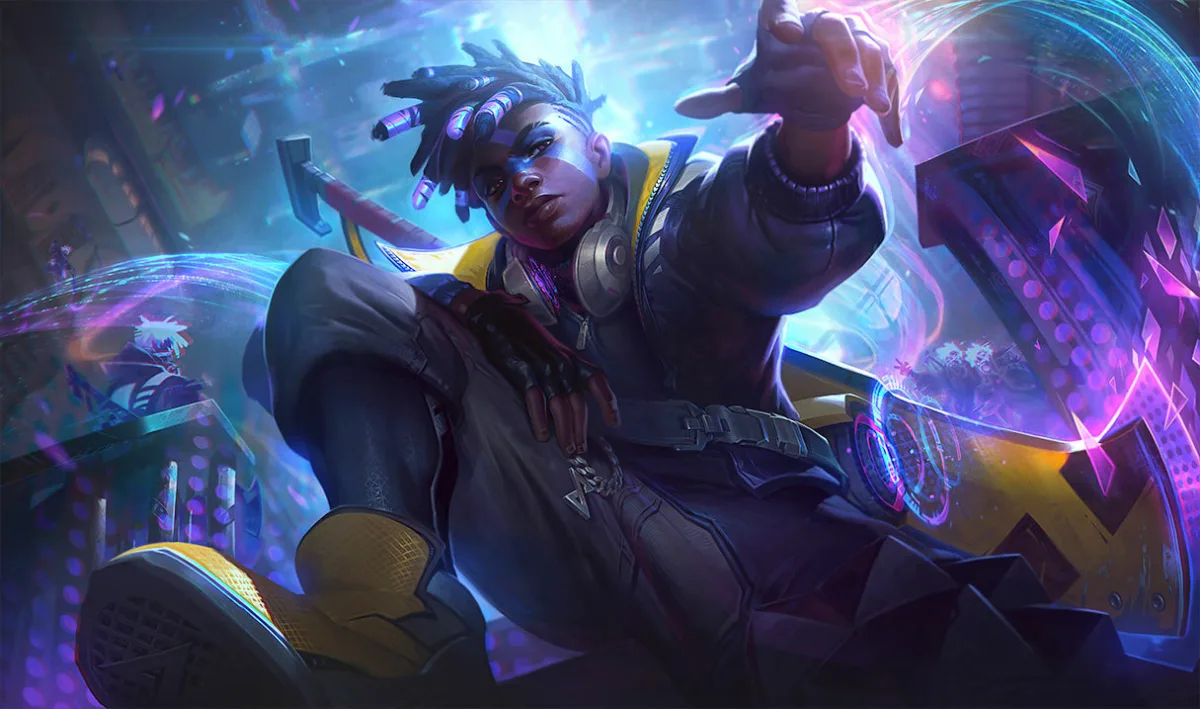
True Damage wins by rebuilding Ekko’s movement, voice, weapon, music, passive rhythm, W staging, and Chronobreak around the same hip-hop performance. Image: Riot Games.
True Damage Ekko is the only skin in this ranking that changes how the time between abilities feels.
The new voice and animation set matter before any large effect appears. Ekko shifts his weight, carries the weapon, attacks, stops, and accelerates with a musical looseness that the Epic skins cannot borrow from a color palette. The bat becomes performance equipment as much as a weapon. Repeated actions feel intentionally syncopated rather than like base motions wearing new particles.
Z-Drive Resonance is the proof. The early marks establish a purple club-like pulse without shouting. The third hit lands as a beat, triggers a brighter circular graphic, and flows directly into Ekko’s faster movement. There is no awkward pause between proc and escape. Timewinder behaves like a physical disc on both legs, then picks up visual intensity as it turns back. The skin makes the return feel like a refrain, not a reused projectile.
Parallel Convergence stages a complete miniature performance. Its waiting field resembles a large record, dial, or speaker surface. The center holds the eye while outer rings define the area. When Ekko enters, the shield and stun add a second burst rather than replacing the field’s identity. Phase Dive is shorter and harder, using animation and contact sound to cut through those large W shapes.
Chronobreak closes the track properly. The afterimage is a purple-blue performer frozen in the earlier beat. Ekko’s body rewinds through a stretched trail, and the landing erupts as a dense violet disc with a bright central impact. It feels large because the animation, sound, and color arrive together, not because Riot filled the whole screen with unrelated particles.
The Legendary has a cost beyond 1,820 RP. Its voice is different, its music can become the dominant texture of a long session, and players attached to base Ekko’s sharper Zaunite delivery may prefer Last Stand or Firelight. Eight chroma children provide model colors, but the parent remains the ranked object here.
No other Ekko skin completes every checkpoint at the same level. Last Stand has a cleaner modern W. Firelight has the best homeguard. Breakout has an excellent piano variation. Trick or Treat has the most charming single theme. True Damage is the one that connects proc, throw, setup, blink, ghost, rewind, voice, movement, and music into a continuous performance. That is why it remains first.
The four comparisons that actually change a purchase
True Damage or Breakout True Damage?
Buy True Damage. Breakout offers a sharper black-and-white model, piano-key details, a weapon visualizer, altered Q and W elements, and a changed music layer. Those are real changes, not an ordinary chroma. They still sit on the original Legendary platform, while access has historically required limited, pull-based systems. The fixed-price original provides the voice, animations, complete spell package, music, and ordinary chroma ecosystem without that access burden.
Breakout makes sense for a collector who specifically wants the hip-hop piano direction and understands the current live acquisition route. It is not the sensible first Ekko purchase.
Arcane Firelight or Arcane Last Stand?
Choose Firelight for the mask, hoverboard homeguard, green-gold palette, and a version of Ekko built around leading his community. Choose Last Stand for the stronger in-combat graphic system, sharper W activation, and richer Chronobreak. Last Stand wins this ranking because most of the article’s test happens after minions arrive. Firelight may win a character-fantasy decision before the loading screen ends.
Last Stand is marked Legacy in both secondary records. Firelight is labeled Legacy by the Wiki module but not by the CommunityDragon 16.17 client export. Check the client rather than assuming either can be bought on demand.
Pulsefire or PROJECT?
Choose Pulsefire if you want clean clocks, measured circles, a bright afterimage, and effects that separate well when several delayed spells overlap. Choose PROJECT if you want darker armor, green wireframes, a hacker identity, and a more aggressive digital filter. Pulsefire looks newer and reads as one disciplined system. PROJECT has more grit and a better story for Ekko as an infiltrator.
Star Guardian or Prestige Star Guardian?
Prestige is the stronger visual edit. Its cool teal-white palette gives Q, W, and R more room, and its streetwear model fits Ekko better. The standard skin has the more colorful magical-hero identity plus nine chroma children. Neither changes his voice or movement enough to justify chasing rare access unless the Star Guardian universe itself is the reason you are buying.
What should you buy for your budget?
- Best complete skin: True Damage Ekko at 1,820 RP.
- Best 1,350 RP skin: Arcane Last Stand Ekko when its Legacy access opens; Pulsefire is the safer ordinary-store alternative.
- Best Arcane skin: Last Stand for combat effects, Firelight for character identity and homeguard.
- Best inexpensive skin: Sandstorm Ekko at its 975 RP record.
- Best fun theme: Trick or Treat Ekko when available.
- Best rare cosmetic: Breakout True Damage on visual quality, but only for buyers comfortable with its current live access route.
- Best reason to spend nothing: Base Ekko remains better than Academy if new combat effects are what you want.
If rare acquisition is the real priority, compare the wider context in our rarest skins in League of Legends guide. Prestige collectors can also use the best Prestige skins ranking to decide whether Ekko deserves rotating currency ahead of other champions.
How many Ekko skins are there?
Ekko has 12 non-base parent skins in Data Dragon 16.17.1. Add the default model and there are 13 parent cosmetic identities in the current gallery. Data Dragon also exposes 46 chroma children, bringing the raw record total to 59.
That distinction matters because the record list is not the purchase list. Sandstorm’s seven named chromas are child records under Sandstorm, not seven extra skins in this ranking. Star Guardian has nine chroma children. Arcane Last Stand has one Paragon child. Prestige Star Guardian and Breakout True Damage are different: Riot and the catalog treat each as its own non-base parent, so both receive their own rank and splash.
The current 12 parents, in release order, are Sandstorm, Academy, PROJECT, SKT T1, Trick or Treat, True Damage, Pulsefire, Arcane Firelight, Star Guardian, Prestige Star Guardian, Breakout True Damage, and Arcane Last Stand.
Do any Ekko skins change gameplay?
No. Skins do not change the mechanical rules described in Ekko’s current kit. Z-Drive Resonance still pays off on the third attack or damaging spell against the same target. Timewinder still travels out and returns. Parallel Convergence still prepares a delayed anomaly, then grants a shield and stuns enemies when Ekko enters it. Phase Dive still rolls before its empowered attack teleports to the target. Chronobreak still rewinds Ekko to an earlier position, heals him under its rules, and damages enemies near the arrival point.
The skins change presentation: models, particles, animation sets where specified, audio, voice in True Damage’s case, recalls, homeguards, and access. A player may prefer one sound or color because it is personally comfortable. That preference should not be turned into a factual hitbox, timing, or competitive-power claim.
The best Ekko skin earns the second look
The easiest way to judge an Ekko cosmetic is to ignore its biggest screenshot and watch what comes back.
Academy has a good outfit, but the base skin returns. Star Guardian throws plenty of color, but its soft magical shapes do not always return with Ekko’s usual snap. PROJECT sends out a strong green blueprint and receives an older digital finish. Sandstorm turns a modest budget into a complete artifact. Trick or Treat sends a pumpkin into danger and receives the punchline. Firelight and Last Stand return two excellent versions of Arcane’s Ekko.
True Damage sends every beat through the same system and gets a stronger beat back. The third proc, the Q return, the W activation, the E impact, and the Chronobreak explosion all feel like parts of one track. After 12 skins and two trips through every spell, that continuity is still the catalog’s best result.