
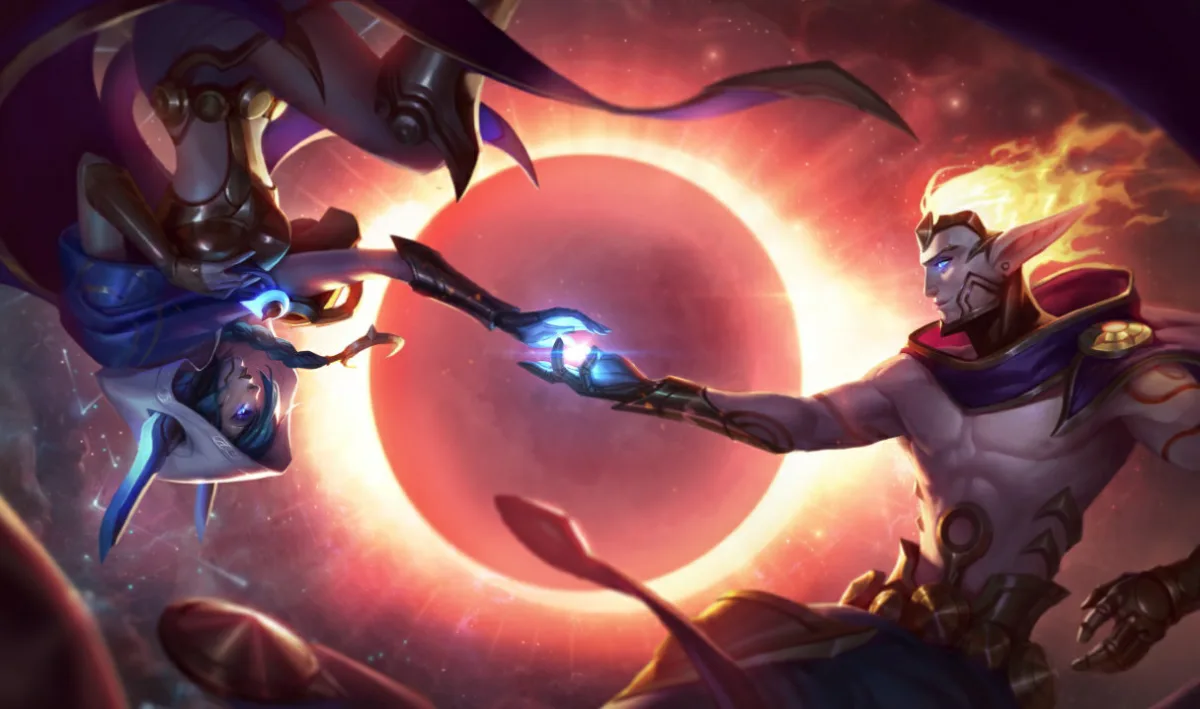
Rakan lands a knockup past the minions, but his ADC is busy backing away from the enemy support. Nobody attacks the airborne target. Worse, the ally Rakan wanted to dash back to is now farther away. Before choosing an ADC for him, decide how the two of you will avoid that trade.
Xayah is the best starting choice with Rakan because their partner-specific effects improve both fighting and retreating. Kai’Sa is the stronger alternative when you need to follow him onto a distant target. Lucian rewards shorter exchanges, Samira wants time to finish an all-in, and Jhin can contribute to a catch without entering it himself.
These recommendations are for a farming ADC beside support Rakan. The order reflects kit compatibility and the decisions each duo asks you to make, not measured pair win rates. None is a guaranteed winning lane. Some want you beside Rakan’s target; others let you contribute without following him that far.
Rakan’s five ADC partners differ in how they follow an entry and what they need when he returns. These recommendations use normal PC bot-lane roles and prioritize a reachable fight over a combo that only works when both opponents cooperate. Riot's 26.18 notes.
Which ADC fits the fight you want?
| ADC, in recommended order | Best reason to choose them | Before committing |
|---|---|---|
| 1. Xayah | Shared combat effects and extra Battle Dance reach | Check where her Feathers will return |
| 2. Kai’Sa | Join a marked-target dive after level six | Clear nearby minions and choose a safe R landing |
| 3. Lucian | Turn a shield or immobilization into a short trade | Keep enough distance to leave after the double shots |
| 4. Samira | Extend a knockup and continue into a close fight | Identify the enemy spell that can stop her ultimate |
| 5. Jhin | Add a root from behind Rakan’s landing | Check ammo and the first champion in W’s path |
Xayah ranks first for the most complete two-player interaction. The remaining order favors direct follow-up over a slower catch plan. Jhin moves up if your team already has enough champions diving forward and needs an ADC who can help from farther back; Samira moves down when the enemy can hold reliable crowd control for her arrival.
Rakan needs somewhere useful to return
Battle Dance, Rakan’s E, takes him to an allied champion and shields that ally for three seconds. He gets one recast within five seconds. Xayah receives the extended cast range; other ADCs do not. This is a targeted ally dash, not a free dash to the nearest empty patch of ground. The ordinary client record also prevents casting it while rooted. Rakan’s current client data and its English ability text establish those restrictions.
Before Rakan goes in, look for a position where you can attack his target and he can dash toward you afterward. That rarely means standing on top of him. If the enemy support controls the space you would have to cross, wait. Following a bad W through that space exposes both of you.
Grand Entrance also has a delay after Rakan arrives. Riot documented the 0.35-second arrival delay in Patch 9.2, and the current PC ability reference retains it. The resulting knockup lasts one second in his current normal spell record. A dash into the circle is therefore not proof that the enemy will be knocked up. Wait for the hit before spending an escape spell to follow.
At level six, The Quickness gives Rakan four seconds of increased movement speed, but an individual champion is charmed only on the first contact. That charm lasts one second at the first rank, rather than the ultimate’s entire duration. Rakan also cannot cast W or Flash during R’s first half-second. That restriction comes from Riot’s Patch 9.9 notes, preserved in this archive, and remains documented in the current PC Rakan reference. Do not plan an instant R-W-Flash sequence from outdated clips.
Fey Feathers is Rakan’s own passive shield; Battle Dance shields its allied target. An intact shield on Rakan does not mean his ADC has the same protection.
Gleaming Quill, his Q, hits the first enemy in its path and enables a heal only if that enemy is a champion or epic jungle monster. The heal occurs after three seconds or earlier when Rakan touches an allied champion. A Q stopped by a lane minion does not provide the same sustain. That gives ranged opponents a reason to keep minions between themselves and Rakan.
1. Xayah: the extra reach matters after the engage
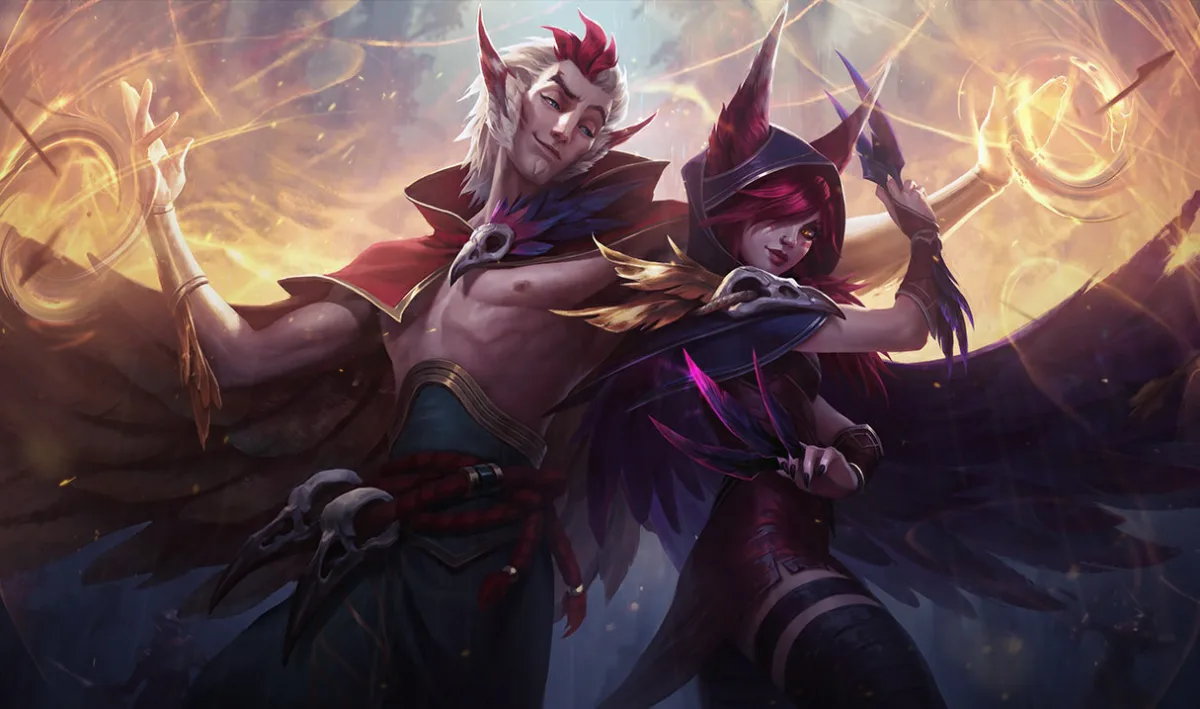
Xayah stands beside Rakan with her feather blades drawn.
Xayah gives Rakan more room to work. She can stand farther away than another ADC and still be in range of his E, which matters when she wants to attack from behind the fight. Her own attack range stays the same, though. Rakan can reach enemies she cannot immediately hit, even with his ideal partner selected.
Deadly Plumage rewards fighting close enough to share it. When Xayah casts W with Rakan nearby, he receives its attack-speed and secondary-blade effects too. His movement-speed trigger depends on Xayah’s hits, rather than his own attacks. Xayah’s current W tooltip spells out that exception. Give him a chance to use the buff before he leaves the exchange.
In lane, work backward from Bladecaller. It needs at least three returning Feathers to hit the same opponent to root them. Q supplies two Feathers, and a passive-empowered attack supplies another, but the lines still have to cross the target when E pulls them back. Rakan’s W can give you time to place those lines. It cannot fix Feathers that are sitting on the wrong side of a champion. Xayah’s normal spell records contain the three-Feather requirement and the damage rules.
A useful lane trade is to keep the target near your half of the lane, let Rakan connect, and add your damage from a position that also allows his retreat. If the enemy steps toward you to punish him, that can improve your return lines. If they escape sideways and the root angle disappears, stop forcing E as though the opening guaranteed it.
This pair also has a defensive answer after level six. Featherstorm makes Xayah untargetable while she throws out more Feathers. Against a diver reaching her, Rakan may get more value from charming that diver and shielding Xayah than from continuing toward the enemy backline. Her ultimate is not invulnerability or a cleanse for effects already applied, and spending it aggressively leaves her with fewer answers to the next threat.
Xayah is especially appealing when opponents will eventually have to come toward her. She has a harder lane when ranged opponents can keep the pair off the wave without offering a close exchange. Do not concede several waves chasing a perfect W-E play; the special pairing bonuses do not replace that farm.
2. Kai’Sa chooses where the dive ends
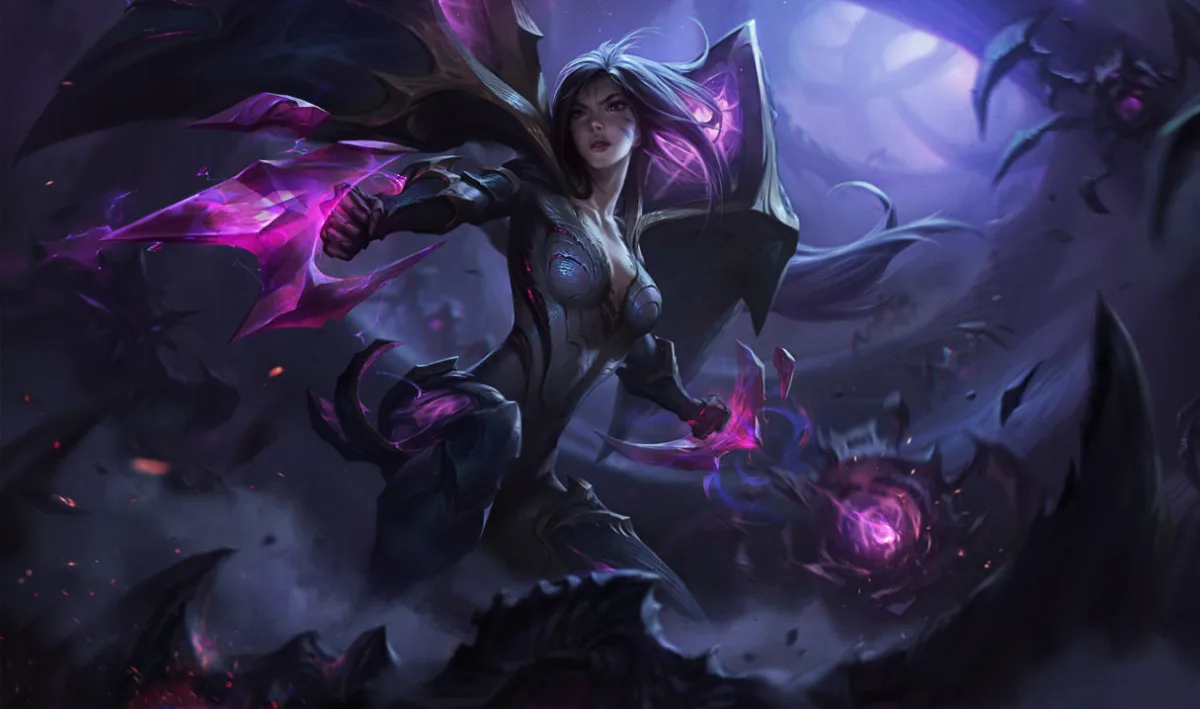
Kai’Sa faces Void creatures in her default splash art.
Kai’Sa can turn Rakan’s contact into a destination. Nearby allies add Plasma when they immobilize a champion, so his knockup and charm contribute to her passive. After level six, Killer Instinct lets her move near a Plasma-marked enemy champion within range and gain a shield. The ultimate gets her into position; it does not deal the burst damage that finishes the target. These are the conditions in Kai’Sa’s current normal records.
Before level six, Kai’Sa has to walk into damage range. Watch the minions around the opponent Rakan wants: Icathian Rain spreads its physical-damage missiles among nearby enemies. He can land W perfectly beside a full wave and still leave you with a weak Q on the champion. Thin that wave when you can, or wait for the opponent to step away from it. Her attack-based Plasma damage is magic, so the pair’s damage is mixed rather than purely physical.
Once R is available, choose the landing point before clicking it. Arriving beside the target on your team’s side can preserve a route toward help. Arriving behind them may expose Kai’Sa to a second opponent Rakan has not controlled. His shield dash follows allied champions, so your position also changes where he could retreat. If both of you end up deep in enemy territory, E still exists, but it is no longer taking him somewhere safe.
For example, a Rakan flank near dragon may put Plasma on the enemy carry while Kai’Sa is still near her front line. If the enemy support is waiting beside that carry, she can keep attacking from her present position and hold R. The mark offers an option; it does not settle the target choice. Jumping in becomes more attractive after the defender has used the spell that would stop her attacking.
That difference between a reachable target and a supported landing keeps Kai’Sa second here. She can join a distant engage after six, but Xayah is the better starting point when the duo primarily needs to defend its ADC. Kai’Sa’s R is most useful when she can fight from the position it gives her.
3. Lucian can take the trade and leave
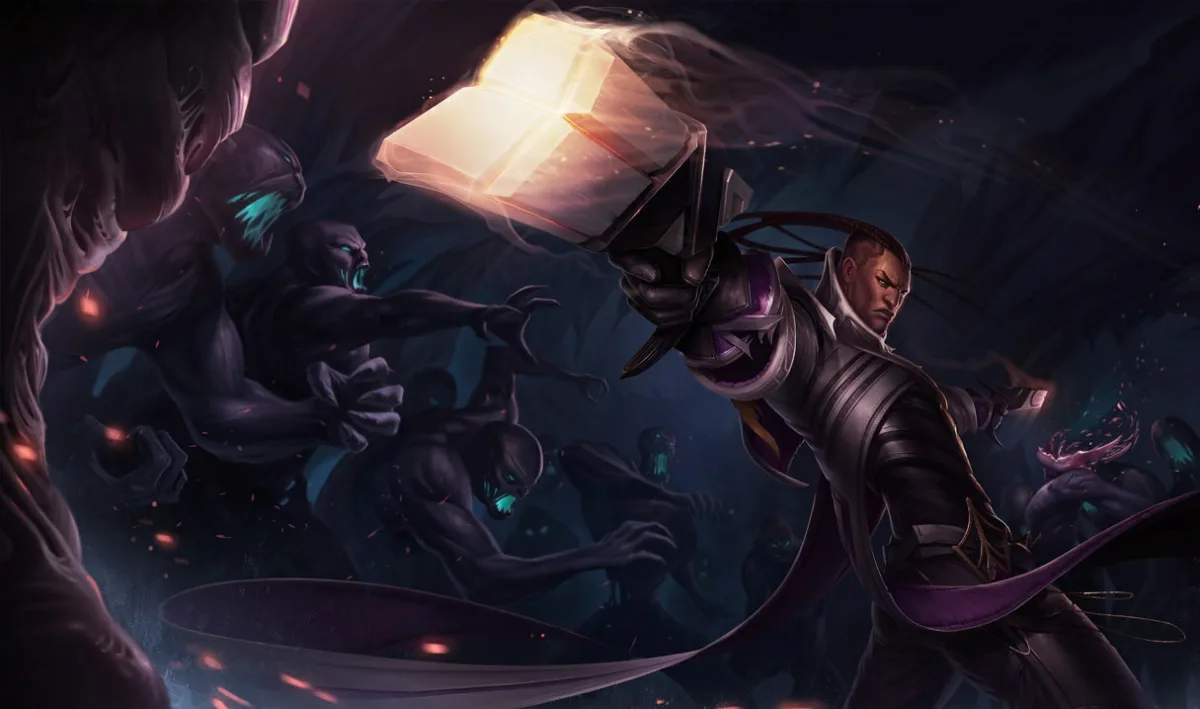
Lucian fires into a crowd of spectral attackers.
Lucian gets a damage benefit even from Rakan returning to shield him. Battle Dance can activate Vigilance, adding magic damage to Lucian’s next two basic attacks. Rakan healing him with Q or immobilizing a nearby enemy with W or R also meets the passive’s conditions. There is another opening through Lucian’s W: if Rakan damages its marked target, that ally-triggered proc grants Vigilance too. Lucian’s current passive and W text documents those triggers.
Start with a short trade: Rakan shields Lucian, Lucian casts an ability and follows with Lightslinger’s double shot, then both players back off before the enemy can answer freely. If Rakan’s W lands, you can reassess. You do not have to spend both champions’ dashes just to make the exchange worthwhile.
Lucian’s 500 base attack range makes positioning demanding. If Rakan starts while Lucian is still several steps away, the crowd control may expire before the empowered attacks arrive. Lucian can spend Relentless Pursuit to close the gap, but that also removes a way to dodge the return spell. Riot’s current Lucian data gives the attack range; the normal client records supply the spell conditions.
This is the pick for a player who wants repeated chances to punish the opposing ADC for walking up to a last-hit. It is a worse fit if your Rakan always chooses long flanks while you want to remain behind the front line. After six, The Culling can follow control from a distance. Each bullet collides with whichever enemy is first in its path, so check for a minion wave or frontliner before channeling at the carry behind them.
4. Samira cannot borrow Rakan’s escape

Samira flips a coin with her sword visible behind her.
Samira benefits specifically from Grand Entrance’s knockup. When an immobilized enemy is within her passive’s dash reach, she can use that attack to move into attack range. Attacking an already airborne enemy can also keep that enemy airborne briefly. Rakan’s charm enables the dash interaction but does not become a fresh knockup. Her current passive tooltip makes that distinction.
Samira’s problem comes after that first contact. She wants to alternate damaging attacks and abilities, build Style, and reach S rank for Inferno Trigger. Rakan may already want to E to someone behind the fight. Without an agreed all-in, she can end up alone among the enemies while he retreats.
Wild Rush will not dash her to an allied Rakan. It requires an enemy target, including structures. The cooldown refreshes on a champion death if Samira damaged that champion during the previous three seconds. That is a conditional second dash, not a promised exit from an unsuccessful attempt. Her W destroys enemy missiles in its area; it does not remove every kind of crowd control. Those limits are present in Samira’s ordinary spell records.
Choose this duo when the rest of the team can remain in the fight with Samira or when the lane offers a target she can reach without crossing the enemy support’s strongest answer. Rakan can save later contact or a shield for her instead of spending everything to start. If the opposing support can simply wait for Samira to enter, a short Lucian trade or a Jhin catch asks less of the same opening.
5. Jhin makes the catch without joining the dive
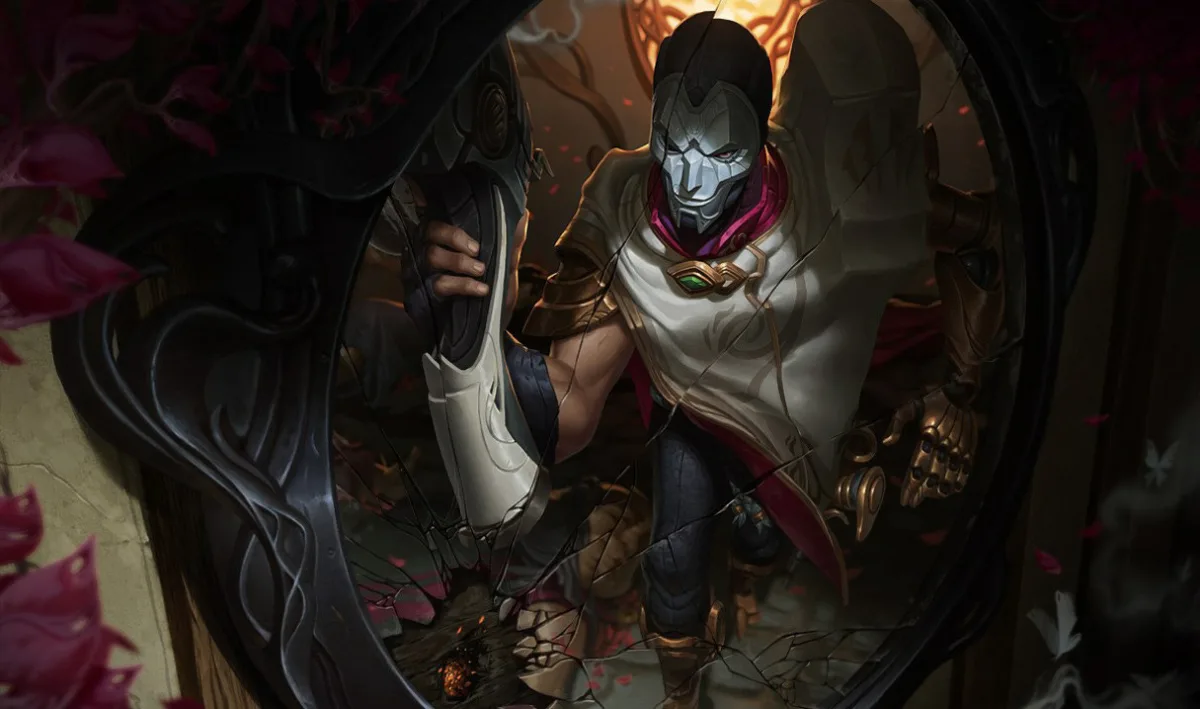
Jhin appears in a cracked mirror surrounded by petals.
Pick Jhin when you want to help Rakan catch someone without dashing in afterward. Damage from Rakan marks a champion for Deadly Flourish’s root. Jhin can fire W through minions from behind the play, but the first champion in its path stops it. A tank stepping across that line can spoil the follow-up. Jhin’s normal W record gives the mark a four-second window.
Jhin fires four attacks before reloading, so check the chamber before calling for W. With shots ready, he can move up and add damage before Rakan leaves. During a reload, Deadly Flourish may be a way to hold the enemy off rather than the start of a kill. Announcing an empty gun is more useful than landing a root and assuming Rakan understands why no attacks followed.
There is a good reverse sequence too: Rakan’s Q damage lets Jhin threaten the root, and that root can make a later Grand Entrance easier to place. Rakan does not need to begin every exchange by jumping. This is especially useful when a direct W approach is obvious enough for the enemy to sidestep.
At six, Curtain Call lets Jhin remain far behind an engage, but channeling there changes the support’s escape route. Do not assume Rakan can dash all the way back to him. A nearer teammate may need to be the E target while Jhin fires. The long-range shots also stop on the first champion, so the pair needs a clear line, not merely a visible carry.
Jhin sits fifth because chasing a brawl from target to target is a poor use of his limited shots. Move him up when the team wants to catch one opponent and stop. The broader support guide for Jhin compares that job with partners who bring different forms of control.
Before following Rakan, check the other player
At level two, check the abilities both players actually learned. Rakan with W and E has engage and an ally dash, but no Q heal. W and Q leave him without Battle Dance. An ADC missing their follow-up spell cannot repair that difference just because the duo reached the level first.
After forcing the opponents back, decide what the trade bought you. If both enemies have left and you can safely push your minions into their turret, help finish that push before resetting. Rakan leaving immediately to roam can strand an ADC who spent mana and health on the trade but still has to fix the wave alone. If the enemies remain close enough to contest, do not chase a nearly dead carry and abandon the minions you can safely collect.
In a replay, pause when Rakan commits and look at the ADC rather than the landing circle. Check whether they can attack from there and whether Rakan has a reachable ally in safer ground. Then watch any dash the ADC spends before W connects. That can show where the duo stopped playing the same fight, even if the knockup itself looked good.
Tell Rakan what you can add to the next opening: a few empowered attacks, a root from behind him, or a committed dive. Then stand where that contribution is possible. If the highest-ranked available pick is unfamiliar, use a partner whose damage sequence you know instead of learning it during the first engage. Champion select gives the duo its options; the position beside the wave determines which one you can use now.