

"Pick a safe ADC and let Bard roam" leaves out half the agreement. The ADC still needs a wave they can reach, enough health to collect it, and a reason to expect their support back. A blink is useful. It does not clear two enemy waves or make the opposing jungler disappear.
Ezreal is our first pick with Bard when the plan includes short, sensible absences. Jhin is the alternative for players who want to turn Bard’s return into a catch. Caitlyn, Sivir, and Ashe complete our five best ADCs for Bard. These choices are based on their tools and lane requirements, not measured duo win rates. The ADC farms; Bard plays support.
Bard loses armor in 26.18: 34 to 32 at base and 5 to 4.7 per level. His portal, binding, and stasis rules remain the same. The roam plans below still require an affordable wave and a return route, with less room to absorb physical damage while creating them. Riot's 26.18 notes.
Choose what Bard’s absence is supposed to achieve
Before Bard moves, name what the trip buys: a useful ward, a reachable fight, or a route that gathers chimes without delaying his return. Otherwise you are giving up bot-lane pressure for no clear purpose.
Leave after solving the wave, not after spotting a chime
A completed crash, with your minions actually reaching the enemy turret, often gives Bard room to move. While his ADC recalls, he can check a nearby entrance or take chimes on the way back. Before adding a mid-lane detour, look at the next waves and who can reach bot ahead of him.
An unfinished push asks more of Bard. If the enemy holds your minions outside turret range, your ADC may be unable to approach the wave after he leaves. Ezreal’s Q still needs a clear line from a position he can reach. Help break that hold first, then reconsider the trip. His lower 26.18 armor makes standing in the enemy ADC’s attack range more expensive. Help from a binding angle or while the enemy is occupied with minions; do not spend so much health finishing the push that the planned roam becomes a forced recall.
A large enemy wave is approaching your turret. Draven is healthy, Nautilus has his ultimate, and their jungler is missing. Calling the ADC "safe" does not remove Nautilus’s targeted, pursuing knockup or Draven’s attacks. Bard needs to help thin the wave or arrange a defense before leaving. If neither is possible, the ADC may have to give up the wave; staying under the turret and hoping for a distant Bard to arrive is not a defense.
Chimes reward Bard with experience, mana and out-of-combat movement speed. Collecting them also upgrades his attack-assisting meeps, which gain slow and area-damage effects as he gathers more. Check his current upgrades before expecting a meep attack to supply those effects. The rewards belong to Bard; they do not replenish his partner’s health or replace missed farm.
Put the healing on the route the ADC can use
Caretaker’s Shrine takes five seconds to reach its full heal. The first ally to enter consumes it for healing and a brief movement boost; an enemy champion can destroy it by stepping on it. Bard can have three placed shrines while the ability holds up to two charges. Those are different limits, confirmed by the current client values, mirrored by CommunityDragon. Riot reduced maturation from ten seconds in patch 13.18.
Place shrines where the ADC can retreat to them, rather than where an enemy support can remove them for free. Let one mature when there is room to wait. Take it early if the immediate heal or movement is what keeps you alive. A shrine behind the fight is useful only if the ADC can reach it; it is not an automatic heal delivered while Bard walks away.
Ezreal: preserve farm without promising the whole wave

Ezreal can collect some minions outside his basic attack range while saving Arcane Shift. That earns him the first recommendation here: he has a way to limit losses without needing Bard beside him for every last-hit. It does not promise every minion, especially when both opponents can walk him away from the wave.
Mystic Shot hits the first enemy in its path. If a healthy melee minion blocks the low-health caster behind it, Q does not give Ezreal a free choice of last-hit. The enemy support can also stand far enough forward to make reaching that angle dangerous. He can rescue individual minions; he cannot promise full access to a wave that two opponents control.
Choose the minion before choosing the movement. Aim for the cannon you can reach from safety; let the caster go if taking it requires blinking toward both enemies. After using Arcane Shift defensively, tell Bard that E is down. He needs that information before turning a short warding trip into another fight.
Bard returning does not mean Ezreal has to blink forward. Check the binding first. A terrain stun gives Mystic Shot a steadier target, but another unit can still block its line. A slow may leave room for only a spell and an attack. Take that exchange without committing E to a kill Bard has not set up.
Choose Ezreal if conceding a few unreachable minions is acceptable and you want an active poke lane when both players are present. If you want to compare Bard’s roaming with more continuous lane help, the Ezreal support guide covers other partner plans.
Jhin: keep the fourth shot and the return route in the same plan

Jhin offers a reason for Bard to return to the lane instead of merely passing through it. Bard can damage a champion with Q or an attack, and Jhin can follow with Deadly Flourish. The current W condition is damage from an allied champion within the previous four seconds. Bard does not have to stun first for that follow-up root to become available.
That matters when the target has sensibly moved away from a wall. Bard’s Q damage can still prepare Jhin’s root, even though Cosmic Binding failed to find a second collision. Stasis alone does not meet that recent-damage condition. The reverse sequence can work too: if Jhin roots an eligible target first, Bard has an easier line to a nearby wall or second enemy. Neither order removes the need to hit the spells.
There is a blocker to remember. Deadly Flourish passes through minions and monsters but stops at the first champion. An enemy support can step between Jhin and the marked ADC. Bard approaching from behind the carry does not make Jhin’s line from the front unobstructed.
Check Jhin’s ammunition before choosing the moment. He reloads after four attacks, with extra damage on the last shot. Walking away during his reload into a large enemy wave leaves him short of immediate pressure. Returning while that fourth shot is ready gives the duo a more threatening catch, as long as he can reach. "Fourth shot ready" tells Bard something that "W ready" does not.
Curtain Call can help a nearby Bard skirmish without Jhin walking into attack range. Its reach is long, not global: the current shot missiles have a 3,500-unit range. The four shots also stop on champions. Jhin must choose a firing position and a useful line; he cannot remain anywhere in bot lane and assume Bard’s entire jungle route is covered.
Bring Bard back through the wall
Bard is approaching bot through your jungle; Jhin has kept the wave on your side. The enemy ADC moves toward the lane wall to pressure him. A portal exit near that position could put Bard beside the carry. Before taking it, he needs Jhin’s position and intention: will Jhin follow the catch, or is he staying back to finish the wave?
Magical Journey travels one way through terrain. Enemy champions can take the same portal, but only from its entrance. An enemy at the jungle-side entrance can follow Bard into lane; the opposing duo at the lane-side exit cannot take that portal backward. Check both ends and Jhin’s position before entering.
On arrival, Cosmic Binding slows the first enemy struck. It stuns only when the bolt then finds a wall or another enemy; with two enemies hit, both are stunned. A minion can serve as the first target before the bolt reaches a champion. Two minions can also use up both hits before it reaches the champion you wanted. The second collision is a requirement, not a reward for hitting the ADC once.
The opposing ADC can leave the wall, and their support can move into Jhin’s W line. Bard’s damage still prepares the mark, but the support now threatens to intercept the shot. When that closes the play, finish the wave together or let Jhin step back for his recall. There is no need to chase farther down the lane to make the return worthwhile.
Caitlyn: leave a lane that has earned the break
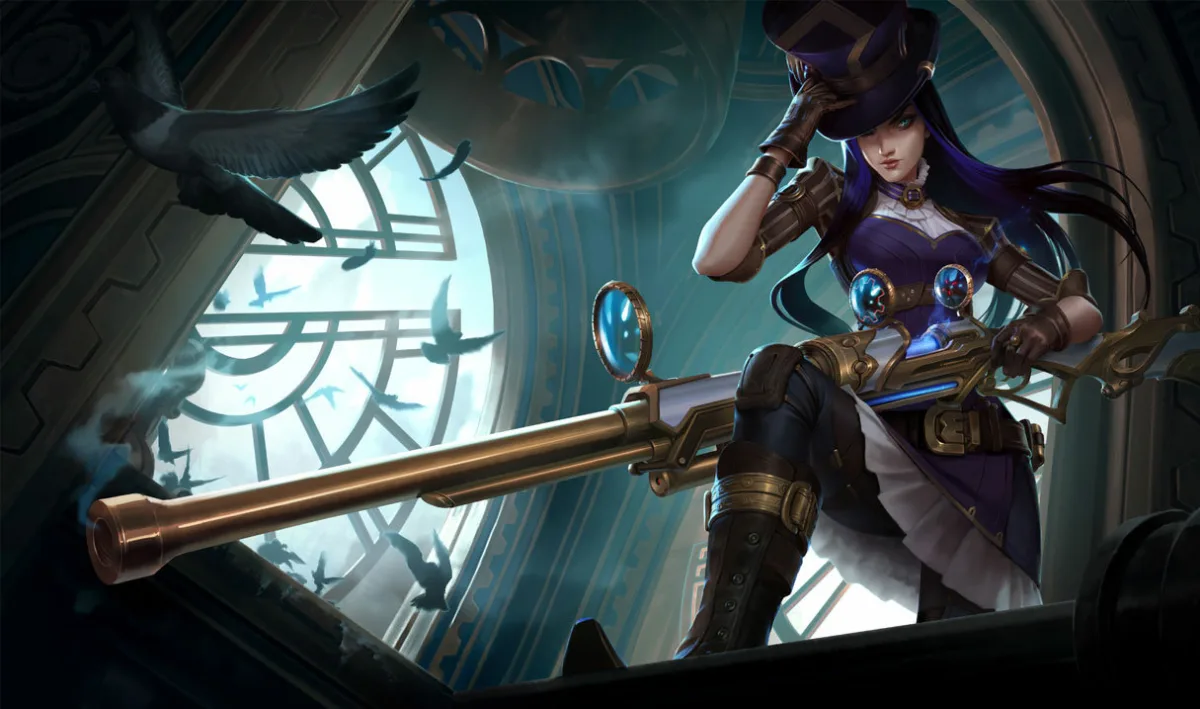
Caitlyn wants to use the time Bard spends in lane. Her 650 attack range lets her harass around last-hits while his attacks and binding angles make approaching her less comfortable. Once Bard leaves, the opposing support can reclaim that space. Pick her to build pressure together, not simply because a long rifle sounds safe alone.
Finish the job together. If the wave needs Bard’s help to reach the turret, leaving to collect nearby chimes can strand Caitlyn beside an unfinished push. Her net has backward recoil and can slow its target, but it is not a substitute for the missing player. Range lets her stand farther away for an attack; it does not stop a support from walking around the wave or arriving behind her.
Tempered Fate gives this pair a distinctive return play. If Bard catches an enemy in stasis, Caitlyn can place a trap beneath that stationary position and prepare to attack after stasis ends. Put the trap down promptly, check whether she can actually reach the target afterward, and leave room for the opponent’s response. The setup is more useful when Caitlyn arrives ready to act than when she spends the entire window walking toward it.
Stasis prevents damage while Caitlyn prepares. She still needs accurate placement and a reachable attack when it ends; an opponent with an available escape can spoil a late setup. Keep Caitlyn outside Bard’s circle so she can do that preparation. Her own ultimate creates a separate timing problem for the pair.
Sivir: make the time away smaller

Sivir’s contribution is often getting the duo out of an awkward wave. Boomerang Blade and Ricochet give her tools to damage multiple minions. If she can finish the clear safely, Bard can move while she resets or while the next wave is still approaching. The important outcome is a smaller absence with less farm exposed, not proving that Sivir can duel two people.
Check Sivir’s mana and where she can stand. Ricochet needs an attack to start bouncing, and her attack range is 500. If the enemy support is between her and the wave, Bard may have to threaten them back before she can start clearing. Leave after she gains that access, not while she is waiting for it.
Spell Shield blocks the next incoming enemy ability and heals Sivir if it succeeds. It is a one-ability answer, not protection against every step of an engage. An enemy can force it with one spell and threaten another afterward. Nor does that shield protect Bard when he chooses an exposed portal exit.
Once both players are back together, On the Hunt can help the team advance or pull away without relying on Bard landing Q first. Do not treat the movement boost as permission to run into the enemy formation. Sivir fits a duo that will take the completed wave and leave, even when a speculative chase is more tempting.
Ashe: help the roam without walking after Bard

Hawkshot gives Ashe a job in Bard’s roam without asking her to walk after him. It can scout anywhere on the map, revealing its flight path as well as the destination. Check the entrance he wants to use before he takes the portal. An empty camp is only information about that area at that moment, not proof that every missing enemy is far away.
After level six, Enchanted Crystal Arrow can support a fight across the map. It stuns the first enemy champion struck, with duration depending on travel distance. Riot’s 12.4 arrow update specifically discusses this cross-map role; the current missile still supports it. Aimed help is not instant help. Check whether Bard can wait for the arrow and whether another champion can intercept its route.
Ashe still has to live through bot lane after firing. Her attacks reach 600 and slow enemies, but she has no built-in dash or blink. If a dive is developing, sending R toward Bard’s mid-lane play spends control she may need against the nearest attacker. Check her own lane before asking for the distant arrow.
When Bard stays, Ashe’s slows can help him approach a binding angle. They do not supply Q’s required wall or second enemy. Choose her if both players will use information and ranged control together, and if Bard is willing to cancel a roam when Ashe needs him nearby.
Decide who casts first before anyone turns gold
Tempered Fate puts affected champions from either team, minions, monsters and turrets into stasis for 2.5 seconds. Affected units cannot act and are protected from damage. That is different from a stun that leaves an enemy available for your ADC to hit. The current Bard client and its English tooltip strings establish the duration and effect.
Suppose Caitlyn’s Ace in the Hole is already traveling toward a low-health target. If Bard puts that target into stasis before the bullet arrives, he protects the enemy from that damage. A well-aimed R can therefore ruin the teammate’s finish. Use stasis to prepare the play first, or let the committed follow-up resolve; do not throw it onto the victim simply because they are nearly dead.
Likewise, Jhin should not spend his Curtain Call shots into an enemy who is still in stasis. Bard may instead isolate another opponent or hold R. If an ally is the one in danger, freezing them can buy time for help to arrive, but that ally also loses the ability to move and attack during the pause.
Turrets are affected too. A friendly turret caught in Bard’s R stops acting while it is in stasis; freezing it is not the same as leaving an active defender shooting the dive. Avoid catching your ADC and their turret together by accident. This is a spell whose target selection can help either team.
The agreement to make before the first wave
Give Bard a condition for leaving and a condition for coming back. "After we finish this crash, take the nearby route; return before their next stack reaches me" says more than "roam whenever." Report a spent escape or defensive ultimate before he adds another detour. If Bard cannot return in time, warn the ADC before they step up for a wave they now need to give away.
Then settle the return play: Jhin needs a marked target and a usable shot; Caitlyn needs time and range for the trap setup; Ashe needs to know whether her arrow belongs to the distant fight or her own lane. Pick the ADC whose part of that agreement you can execute. Bard’s route can change during the game. Your partner should not have to guess that it changed.