

Lucian is the first ADC to consider with Braum when you want short, aggressive trades: Lightslinger lets him contribute two hits to an existing Concussive Blows mark in one double shot. Ashe is a better starting point when the problem is getting Braum close enough to apply that mark at all. Ezreal, Kalista and Kog’Maw earn the other places here by offering ranged follow-up, coordinated initiation and sustained damage behind his shield.
The best ADCs for Braum do more than attack a marked target quickly. Someone has to get that first mark onto an enemy you can reach. A double shot will not help when Braum is throwing Q into minions or losing half his health before he can touch anyone.
Braum’s five ADC options are conditional on how they finish Concussive Blows and survive the reply. The comparison concerns normal PC support Braum alongside a farming carry, without assigning measured duo-win-rate placements. Riot's 26.18 notes.
Choose an ADC for the part of the fight you need
| ADC | What the pairing adds | What can make it fail |
|---|---|---|
| Lucian | Double-shot follow-up and a dash to reach a marked enemy | Spending the dash before Braum connects, especially into a large enemy wave |
| Ashe | Slows that help Braum make contact, then ranged initiation at level six | Both partners can be trapped when the enemy attacks from another direction |
| Ezreal | Mystic Shot can add to an existing mark from outside attack range | Minions block both champions’ Qs, and Q-only trading leaves stuns unfinished |
| Kalista | An Oathsworn engage or rescue, with attacks that reward shared targeting | Pulling Braum away when he was protecting the rest of the team |
| Kog’Maw | Repeated attacks from behind a support who can intercept incoming projectiles | Braum leaves to chase while a second threat reaches his immobile carry |
Stick with an ADC whose attack range and last-hitting you know before learning Kalista solely for this duo. For a broader champion-pool choice, use our ADC guide; these recommendations assume Braum is already locked in.
Braum starts the mark; your attacks finish the job
Concussive Blows needs four stacks to stun. Braum can apply the first with an attack or Winter’s Bite. Once the target is marked, allied attacks can add stacks. An ADC cannot begin marking a fresh target simply because Braum is nearby.
Take a clean Lucian follow-up with no blocked attacks and no expired mark:
- Braum hits the enemy champion with Q. The target has one stack.
- Lucian casts an ability, then lands both shots from the resulting Lightslinger attack. Those two hits bring the target to three stacks.
- Braum or Lucian lands one more qualifying attack. The fourth stack triggers the stun.
The order can vary. If Braum attacks before Lucian’s double shot, the second bullet can be the fourth hit instead. What does not change is the need for four stacks. "Braum Q into one Lucian double shot" is not a complete stun on its own.
The sequence follows the current passive rules and Lightslinger’s separate attack behavior, also documented in Riot’s attack-instance bug fix. It explains which hits count; it is not a measured timing benchmark.
The mark also has an expiry window. Braum’s current data gives it four seconds, refreshed as stacks are added. A target retreating out of range can deny the final hit. After the stun, that enemy temporarily cannot receive new Concussive Blows stacks. Repeatedly attacking them does not create an immediate second stun, though Braum’s own attacks deal extra passive damage during that lockout.
You do not have to switch targets automatically. If the stunned enemy is about to die, finish the kill. If a healthy frontline champion has already absorbed the proc while another opponent runs at your ADC, Braum can start a new mark on the new threat. The useful target is the one your team can punish without losing its damage dealer.
Lucian converts contact; Ashe helps create it
Lucian: the quickest partnership to understand

Lucian’s contribution is more specific than "he attacks fast." His Lightslinger double shot follows an ability cast, so he can prepare the next pair of hits instead of waiting for several ordinary attacks. Braum’s Q creates a visible opportunity, and Lucian has a short dash to reach it.
That makes the lane attractive into an opponent who must come close enough to contest the wave. Braum can threaten a Q when the enemy steps around the remaining minions, with Lucian near enough to follow. Before dashing after a hit, check how many minions and enemy spells you would cross. You can win the short exchange and still lose the chase.
Keep Piercing Light and the double shot separate in your head. Q deals spell damage; the next prepared attack supplies the pair of hits for Braum’s passive. If you have room to attack, use that pair before casting the next spell. A player who keeps casting while backing away may land damage but leave Braum waiting for the attacks that finish his stun.
There is a second interaction that older descriptions often blur. Lucian’s current Vigilance conditions include a nearby enemy champion being immobilized. Braum’s completed stun or ultimate knockup can satisfy that condition; the slow from Q alone is not an immobilization. Stand Behind Me grants resistances, not an ally shield, so do not describe Braum’s W as a shield that automatically powers Vigilance.
Ardent Blaze gives the duo another route. When Braum damages an enemy already marked by Lucian’s W, he can trigger its movement-speed effect for Lucian and grant Vigilance. This is why the current lane offers more than the familiar passive-stack trick. You still need to hit and follow up, but Braum does not need to be an enchanter to contribute to Lucian’s empowered attacks.
Lucian pays for this burst with short basic-attack reach. His base range is 500. Against a lane that can harass him from farther away, spend too many waves looking for a perfect stun and you may arrive at the opportunity without the health to take it. Preserve the dash when the opposing support still has a reliable way to punish the landing position.
Ashe: let the slow do some of the walking
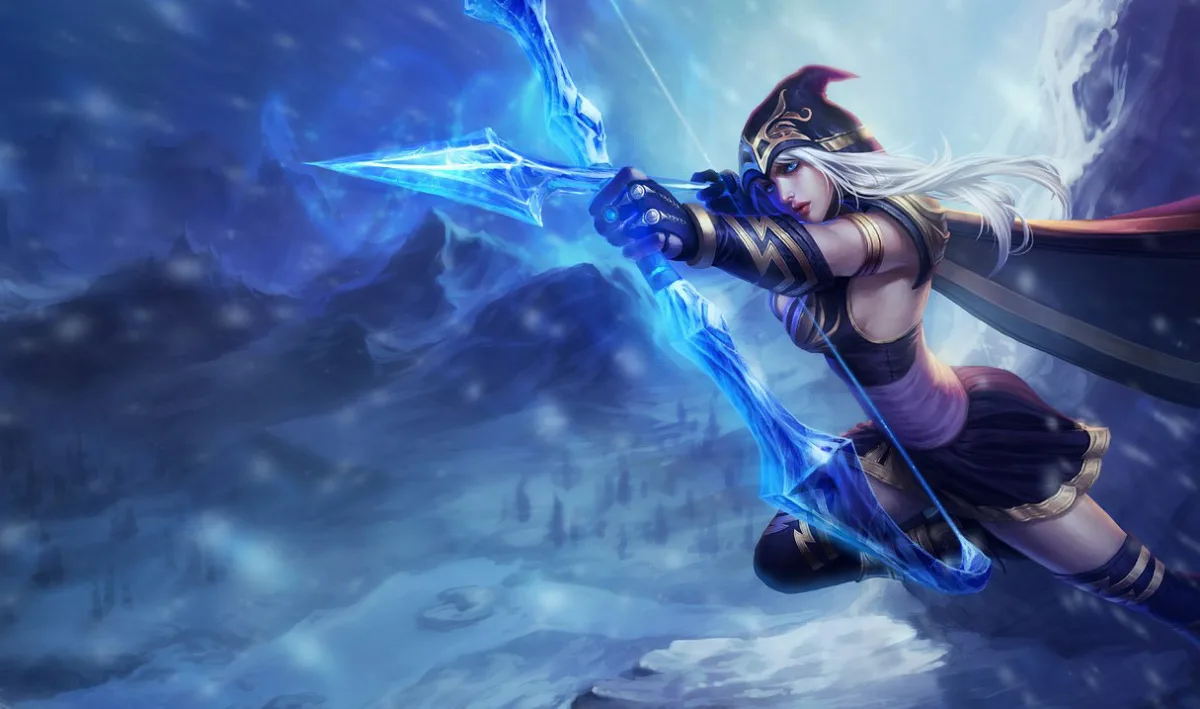
Ashe changes who creates the opening. Her attacks slow and her base attack range is 600, so she can sometimes touch an opponent before Braum can reach them. That slow gives him a better chance to land Q or get into melee range. Once he has marked the target, her next attacks contribute to the stun.
For example, an enemy ADC steps forward for a last hit while their support is too far away to answer. Ashe attacks once and starts moving with the retreating target. Braum takes the space she has created. If minions block his Q, he should not throw it into them and call the setup failed; the slow may still let him threaten a melee attack from an angle.
Ranger’s Focus rewards keeping the trade going, but the animation is misleading. Its flurry has five small strikes, yet Riot’s current extended tooltip specifies one application of on-hit effects per attack. One flurry is not five Concussive Blows stacks. The attack-speed increase helps Ashe make subsequent attacks sooner; it does not let the visual arrows bypass the four-stack rule.
At level six, Enchanted Crystal Arrow can hold a target while Braum approaches to apply his mark. Keep attacking to finish Concussive Blows; you do not need to stop dealing damage to space out the control. The ability you can often hold is Braum’s ultimate. If the target is already safely stunned, save Glacial Fissure for its attempted escape or for the teammate trying to help it.
Ashe also helps with information. A Hawkshot through the relevant jungle approach can reveal whether the river play is worth taking. It is a scouting tool, not permanent vision, and a clear path when the hawk passes does not guarantee the jungler cannot arrive later.
The limitation is mobility. Ashe has no dash, and Braum’s shield faces one direction. Their control is much easier to use against enemies in front of them than against two threats arriving from opposite sides. A confident lane does not justify walking both champions into an unwarded river entrance.
Ezreal can contribute without blinking into the fight

Mystic Shot applies on-hit effects. That lets Ezreal add a Concussive Blows stack when his Q hits a target Braum has already marked. It does not make Ezreal a second Braum: he still cannot use Q to start the passive on an unmarked champion.
This suits a lane where stepping into ordinary attack range would be expensive. Braum lands a mark, Ezreal contributes through an open firing line, and Arcane Shift remains available if the opposing support retaliates. You can accept a small favorable exchange without turning every successful Q into a forward blink.
Minions are awkward for both partners. Winter’s Bite and Mystic Shot hit the first enemy in their path. Braum’s Q may reach a champion through an opening that closes before Ezreal fires. Recheck the line: a shot into a minion adds nothing to the mark on the ADC behind it.
Ezreal must still attack when it is safe. His passive grants attack speed from ability hits, and leaving ordinary attacks out of a close trade throws away both damage and opportunities to finish Braum’s stun. The practical distinction is whether you can attack safely now, not whether Ezreal is a "Q champion."
Arcane Shift can also move Ezreal into a position Braum can jump toward with W. Use that option carefully. A blink toward an exposed target may offer Braum a way in while removing both champions’ route out. For a defensive reposition, move so Braum can join you and face the threat; do not blink across to the other side of the fight and expect his shield to protect both positions.
Choose Ezreal when you value his ability to farm and contribute from range and you already use his attacks properly. If your aim is the most immediate early passive proc, Lucian offers a more direct pattern.
Kalista needs an agreement about Fate’s Call

Kalista’s ordinary attacks help finish Braum’s marks while building spears for Rend. Her hops can let her keep attacking as the fight moves, and Rend adds a slow when she pulls those spears out. That makes repeated targeting of the same enemy worthwhile for both champions.
There is also Sentinel’s passive: when Kalista and her Oathsworn, the ally she has bound to herself, both attack a target, they can trigger bonus magic damage. This requires learning W and satisfying its own conditions. It is separate from Concussive Blows, rather than an extra shortcut around Braum’s stack requirement.
Fate’s Call is the big attraction. With Braum as her Oathsworn, Kalista can pull him into stasis and offer a launch. Braum controls the launch direction. If he hits an enemy champion, he arrives close enough to threaten a melee attack instead of trying to land Winter’s Bite from outside the fight.
Decide what the ultimate is for before the river fight starts. If it is an engage, Kalista must be close enough to follow the landing, and Braum needs a target worth reaching. Launching the support over a wall while the ADC walks the long way around gives the enemy time to turn on him before the damage arrives.
If it is a rescue, Braum should know that too. Pulling him out can save his life, but it also removes the champion who was standing between incoming fire and the rest of your team. A successful rescue of Braum can still be a losing teamfight if another carry was relying on that position.
Kalista demands the most coordination of these five picks. Her movement and targeting already take practice, and now your support has a launch decision too. If neither of you knows when the other wants to go in, choose a pairing you can communicate with a target ping.
Kog’Maw wants Braum to stay with him

Kog’Maw offers a different reason to choose Braum: let the opponent walk into Kog’Maw’s range instead of trying to force contact with the enemy carry. His Bio-Arcane Barrage supplies extra range and maximum-health magic damage on attacks. Braum can mark the champion entering that range while Kog’Maw keeps firing from behind him.
This is especially useful when a visible enemy front line and ranged damage arrive from the same direction. Braum can face the incoming missiles with Unbreakable and prepare to tag the closest threat. Kog’Maw does not need to walk through that target to reach the back line for the partnership to produce value.
Unbreakable is directional interception, not team-wide invulnerability. Projectiles hit Braum and are destroyed; the first one he blocks deals no damage, while later projectiles from that direction deal reduced damage. It does not erase every hostile ability, and a flanker already beside Kog’Maw has bypassed the position you were defending.
After the first stun, Braum has to decide whether he can leave Kog’Maw. If he runs forward for a second target, can his ADC keep attacking safely? When the answer is no, keep the protective position and let the front line retreat. Chasing a low-health enemy while a diver moves onto Kog’Maw gives away the reason to draft the duo.
Repeated poke can make this lane unpleasant. Braum has no healing ability, and Kog’Maw cannot dash out of a bad commitment. If they lose health before the next wave arrives, forcing a chase makes the problem worse. Stay in experience range where it is safe, give up the exposed last hit if necessary, and look for a recall before the enemy can trap both players under the tower.
When the fourth hit is not worth taking
Suppose Braum’s Q lands while your ADC is finishing a low-health cannon. The marked opponent backs toward their support, and the enemy wave is still large. You have two options: cross the wave for the passive proc, or use the threat to stop the opponent contesting your next few last hits.
The second option can be the better play. A visible mark forces the opponent to respect an attack they would normally take. You have gained space even if the stun never happens. Do not convert that pressure into a losing chase because three stacks look unfinished.
What happens after you spend the movement ability? Lucian needs somewhere reasonable to finish his dash. Ezreal needs a shot that will not disappear into a minion. Kalista needs to know whether Braum is being launched forward or brought home. With Ashe or Kog’Maw, Braum must stay close enough to help if the fight turns.
If the opponent spends an escape to drop the mark, use the space they surrendered to collect the wave. Check the map before following them toward the river. Braum can try again when his ADC is in position for the next Q; he does not have to walk into fog to finish the previous one.