

Use U.GG when you need a recommended setup quickly. Open OP.GG to compare item paths and the games behind them. Choose LoLalytics to inspect the statistics in more detail, or MOBAFire for a guide author’s written explanation.
A quick build is a starting point. The harder shop decisions come later: whether to delay damage for protection, change boots, or abandon a purchase that no longer fits the match. Use these sites to find a default and understand when to change it.
Public browser pages and provider documentation checked September 6, 2026, using Ahri mid as a shared lookup. This is an editorial comparison of visible features, not an independent audit of the providers’ data accuracy. We did not test account features, paid plans, desktop overlays, or automatic rune imports.
Which site should you open?
| Site | Open it when you need | Remember this limitation |
|---|---|---|
| U.GG | A recommended setup for runes, skills, and items | A recommendation still needs the right role and patch |
| OP.GG | Alternative item sequences with their sample sizes | The players completing each sequence are different groups |
| LoLalytics | More detail about builds, filters, and displayed statistics | Read the tooltips before comparing percentages |
| MOBAFire | An author’s reasoning and champion-specific advice | Check the guide’s substance as well as its update date |
Start with one statistical page during champion select. Open a second when you need to check something specific, such as whether an alternative item appears in enough games to merit a closer look.
U.GG: get a setup before the countdown ends
U.GG’s Ahri build page brings the main choices together: runes, a skill sequence, a core build, and later item options. That makes it our starting recommendation for someone who wants a usable reference without first studying a large item table.
Check the role selector before copying. A champion appearing in two positions can have very different jobs and budgets. A support setup is not automatically a cheaper version of the same champion’s mid build.
The U.GG FAQ describes filters for role, rank, region, patch, and matchup. It also explains its recommendation process as looking for a frequently played setup that performs above the champion’s baseline. That is the provider’s description of its method, not proof that its recommendation will beat every alternative in your match.
The FAQ described a Plat+ default when checked; the current Ahri page displayed Emerald+. Read the selected rank on the build page itself, even if you have used the site before.
Copy the starting plan, but identify one likely exception before loading in: a defensive purchase, a different boot choice, or a damage type your opponents are preparing to resist.
OP.GG makes the item path worth comparing
On the current OP.GG Ahri page, item sections show sequences alongside pick rates, games, and win rates. The page also separates later purchases by slot. Use those together: a percentage is much more informative when you can see how many games produced it and where the item appeared.
The checked page included Malignance into Shadowflame, followed by either Zhonya’s Hourglass or Rabadon’s Deathcap. Compare the game counts before preferring a row, then ask why you might want its third item. Zhonya’s active, discussed below, is a specific reason to consider that path, not an instruction to copy it every game.
OP.GG’s role-build instructions explain how selecting an available role changes its item, skill, and rune recommendations. Set that role before comparing paths. During our check, the Ahri page showed Middle, Emerald+, all servers, and ranked solo/duo on patch 16.17.
Later item slots are useful for browsing possible purchases. They are a poor basis for deciding your first item: those rows describe matches in which players got far enough to make the later purchase. You are answering a different question at your first recall.
LoLalytics: pause at the question marks
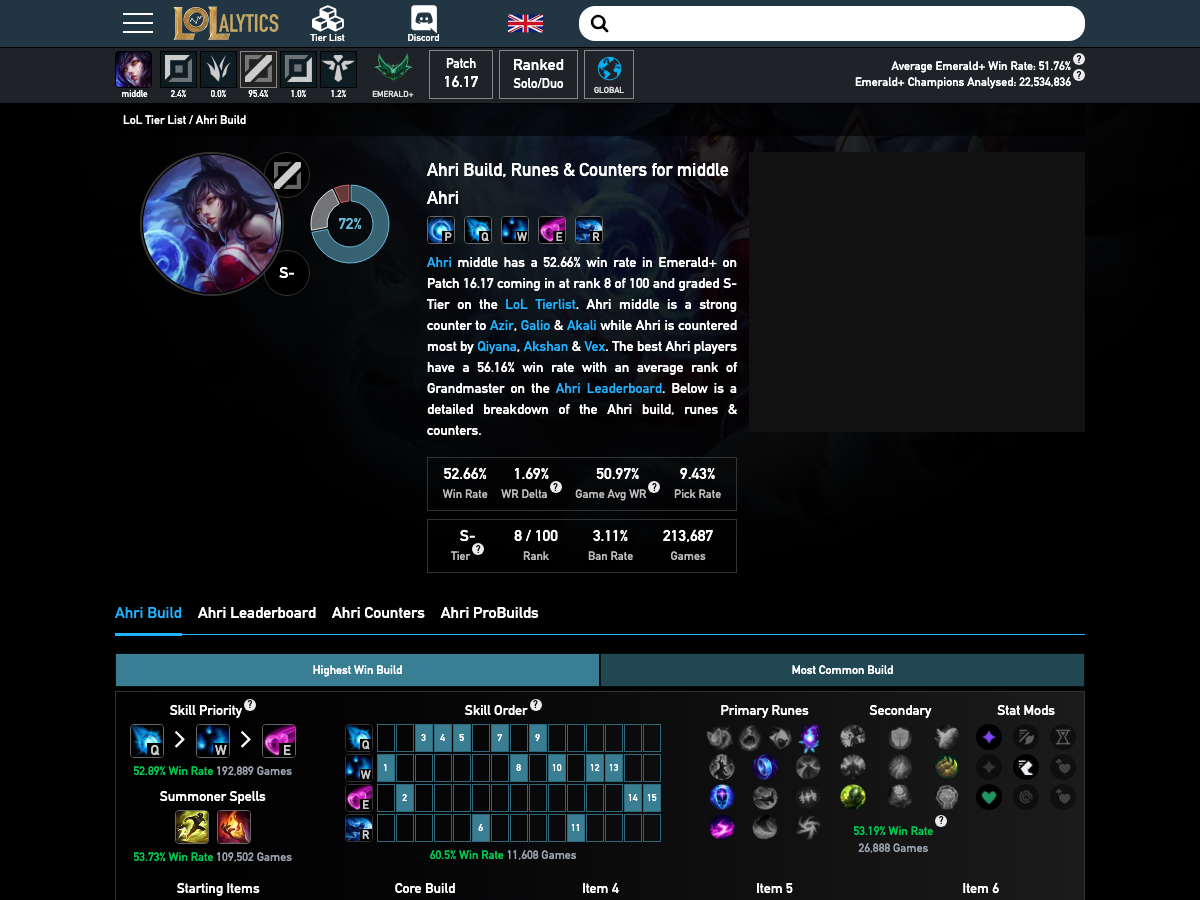
LoLalytics’ Ahri page separates Highest Win Build from Most Common Build and shows game counts within its build sections. Before investigating an unusual setup, check which view you have selected and how many games support that choice.
In the screenshot, Skill Priority and Skill Order have different game counts. Both concern ability leveling, but their percentages describe different samples. Read each section’s tooltip before comparing the results.
The question marks around win-rate and build information are worth opening. Check what a statistic includes before comparing it with a similarly named figure elsewhere; the population or calculation may differ.
MOBAFire is for reading the author’s argument
The MOBAFire Ahri index separates community guides from its statistical build material. It offers role and sorting controls, visible author names, update dates, and guide entries grouped by patch or season.
Look for a guide that explains the decision you are stuck on: an item choice, a matchup, or what to do after lane. A purchase list gives you less to work with than a paragraph explaining when its author changes that list.
A recent date is a screening tool, not a guarantee. Look for current item names, abilities that work as described, and reasons for alternative choices. A “current patch” label cannot fix an old paragraph underneath it.
We checked the guide index, not every linked guide’s full contents. One guide link presented an access check, so we have not ranked individual authors or endorsed a particular Ahri guide’s accuracy here.
Why a 70% item win rate can be a bad shopping instruction

Consider this invented example, not a result from any of the sites above. An item appears in ten recorded matches. Its buyers win seven, so the displayed win rate is 70%. Another item appears in 100 matches, with 55 wins: 55%.
You cannot conclude that buying the first item would improve your chance of winning by 15 percentage points. The two groups may differ before anyone makes the purchase. Perhaps the first item is usually bought when its owner is already ahead. Perhaps the second is purchased when the game is difficult and the player needs help surviving.
Mejai’s makes the problem concrete. Its current Riot item description grants Glory through takedowns and removes ten Glory on death. That gives a player reasons to consider both their existing position and their ability to stay alive. The item does not arrive at random in otherwise identical matches.
The arithmetic also reacts sharply to small samples. Change one of those seven wins into a loss and the first item falls from 70% to 60%. Change one of the 55 wins in the larger group and its rate falls from 55% to 54%. Sample size does not remove selection bias, but it changes how much one result can move the displayed percentage.
There is no universal “enough games” cutoff that makes every filtered item row reliable. Prefer a well-supported ordinary route as your starting point, and require more explanation before trusting a rare exception. Combining more and more filters can make the page look tailored while leaving very little evidence behind it.
When defense matters more than the item win rate

Zhonya’s Hourglass supplies armor and an active that puts you in stasis for 2.5 seconds, during which you cannot take actions. Both are described in Riot’s current item data. Whether that helps depends on the threat you need to survive and what happens when stasis ends.
If you keep dying before your second rotation, “this row has a lower win rate” is not a complete argument against protection. Equally, buying stasis without a useful moment to press it may fail to solve your problem. Name the enemy action you intend to answer, then consider whether the item actually answers it.
Check whether you need protection from the initial spell, time for an ally to arrive, or a safer position before the fight. Buying the item and finding a useful moment to activate it are separate decisions.
Make two build pages comparable before picking a winner
When U.GG and OP.GG disagree, first check that they are describing the same thing. Champion alone is not enough.
Use the same role, queue, rank bracket, region, and patch wherever those choices are available. Then compare the same stage of the build. A most-common first item, a highest-win completed three-item sequence, and a sixth-slot purchase are three different observations.
Patch labels deserve attention too. During this review, U.GG used 26.17 while OP.GG and LoLalytics displayed 16.17. Riot’s North American Data Dragon realm identified champion and item data version 16.17.1. The different labels alone did not establish that one page was behind. Check the actual selected update and its data context before declaring a site outdated.
Even matched visible filters do not prove identical datasets. Providers may define samples or recommendations differently. We have not audited their collection pipelines, and this comparison does not establish a “most accurate” service. If a disagreement survives your filter checks, treat it as a question to investigate rather than proof that one site is broken.
Rows from different pages may describe incompatible spending plans. Buying protection early and rushing damage to exploit a lead can each make sense. Combining their highest-win purchases does not necessarily preserve either plan.
A short routine for choosing and reviewing a build
- Choose your reference page and set the role. Confirm the current patch, queue, and rank filter before reading the recommended items.
- Take a starting plan you understand. Know your first purchase target and the reason for your boots. Do not begin with a rare six-item row simply because it has a striking percentage.
- Prepare one conditional change. Identify the opponent or damage pattern that could make you buy defense, penetration, or another practical answer.
- Revisit the decision after the game. Ask whether your purchase solved the problem you named. One win does not validate a build, and one loss does not disprove it.
Keep a familiar reference for the default build. Change the purchase when the reason for buying it changes.