

Jhin offers to make someone beautiful, and somehow the offer is worse than an insult. That promise leads our four best Jhin quotes. His defense of cruelty comes next, followed by two brief exchanges from his official story that show how unsettling he can be while making ordinary conversation.
We checked the wording in Riot’s biography, its description for Mind of the Virtuoso, and Odin Austin Shafer’s The Man with the Steel Cane. These are written sources, not a list of verified voice triggers. Below, we separate what Riot prints from our reading of why each line works.
Sources and artwork checked September 6, 2026. Story dialogue ends with periods here rather than the commas preceding its speaker attribution.
1. The promise of beauty puts you in his hands
"I will make you beautiful."
From the description of Riot’s official Mind of the Virtuoso teaser, also preserved in Jhin’s official Universe record.
Jhin isn’t admiring what he sees. He has decided that somebody needs changing, and that he is qualified to do it. There is no question for the recipient to answer and no suggestion that they might be happy as they are. The sentence gives him the action and leaves them to receive it.
For a short character caption, that direct address is useful. A stranger could read the sentence as an artist’s offer. Put Jhin’s name beneath it, or his mask beside it, and the flattering possibility turns sour. You have changed nothing in the wording, but knowing who is speaking changes what the recipient has to fear.
The objection is that another controlling villain could say it. His remark about art is more distinctive. We still prefer the promise because it permits that first, mistaken impression of kindness. The threat becomes apparent when the reader recognizes the speaker, rather than when the sentence supplies an obviously ugly word.
Try it with an illustration that leaves the recipient unseen. The pronoun can seem to address the viewer, which is more personal than another caption announcing Jhin’s talent. That’s a suggested use in fan art, not a claim that Riot composed a particular splash around the line.
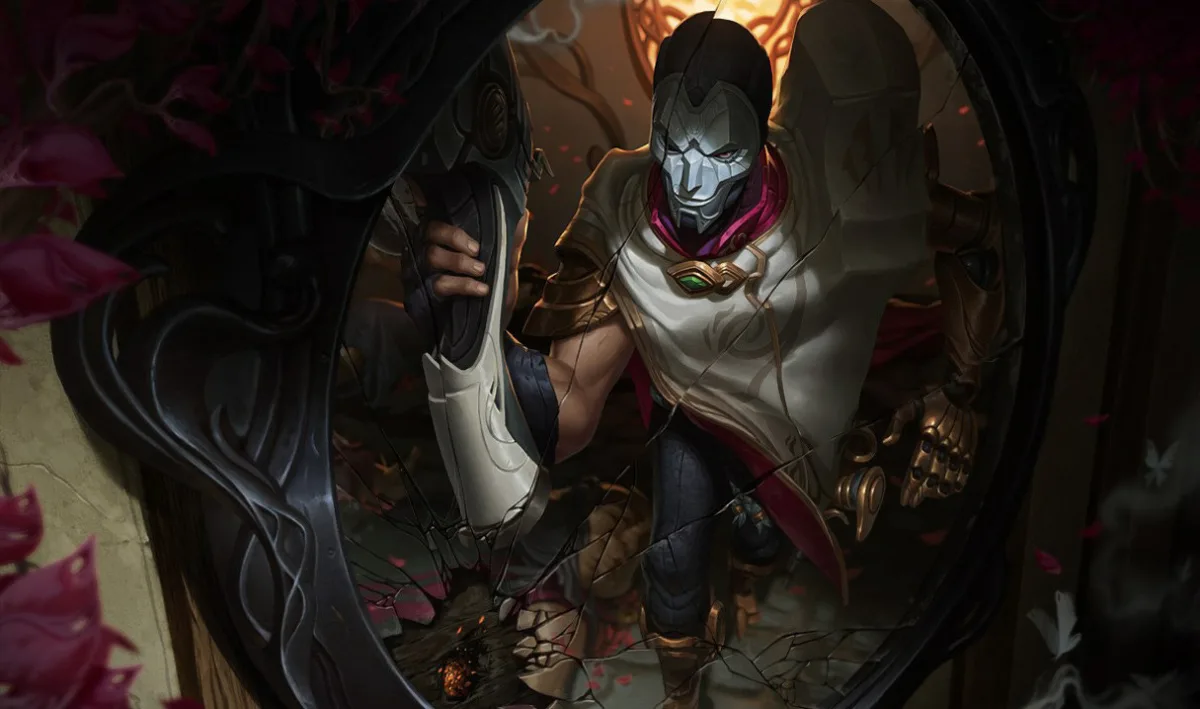
2. His artistic rule tries to settle the argument
"Art requires a certain… cruelty."
The epigraph, or introductory quotation, in Jhin’s official Riot biography.
Here Jhin makes an argument. He treats cruelty as a condition of making art, as though the requirement exists independently of his own wishes. Accept that premise and the conversation becomes a negotiation over the amount of harm, with permission to inflict it already granted.
The biography gives us other perspectives. It identifies the feared Golden Demon as a human stagehand, not the supernatural creature his pursuers expected. The hunt leaves Shen more somber and disrupts Zed’s studies. Those details ask us to consider what Jhin does to other people, beyond the evaluation of his work that occupies him.
This is the line to choose for an argument about Jhin’s self-justification. Is he describing a necessary cost, or giving his preferred behavior a prestigious explanation? We read it as the second. He states the connection with confidence but does nothing to demonstrate it.
The epigraph makes Jhin easier to identify, at the cost of explaining more. It names the unpleasant part outright. For a post about his beliefs, that’s an advantage; for an image meant to become disturbing on a second look, we’d use the promise of beauty instead.
3. Affection becomes an evasive answer
"It’s for the crescendo, my darling."
Jhin speaking to a maid in The Man with the Steel Cane, by Odin Austin Shafer.
The maid has asked about the shape at his shoulder. Jhin answers with a musical term and an endearment. She wants to know what she’s looking at; he tells her where it belongs in his performance. It is an answer that leaves her less informed than its apparent courtesy suggests.
A crescendo is a gradual increase in musical loudness; the word can also refer to a buildup or its climax. Merriam-Webster records both uses. Jhin’s answer directs attention toward what he is preparing to do. The maid is looking at an object; he is thinking ahead to its effect.
The endearment makes the exchange worse. It claims a familiarity the conversation has not earned, offering reassurance the maid has no reason to trust. His reply reads like a gracious explanation to a guest who hasn’t been told what the occasion is.
Of the four selections, this gives you the most to discuss as dialogue. The question and reply take only a couple of sentences to explain. Together they show how Jhin deals with a person asking something reasonable, which is more revealing than giving him an empty stage for another boast.
Keep the maid’s question with the quotation in a discussion. Without it, the affectionate address can suggest a romance the source does not establish. Credit the story when sharing it; that is where this particular exchange can be checked.

4. A quiet beginning depends on what came before
"Then I can begin."
Jhin in the opening section of The Man with the Steel Cane, before the exchange about his shoulder.
The maid has confirmed that she placed the lanterns as he requested. His reply could be a workman’s acknowledgment: the preparations are finished, so the job can start. He gives her none of the grand explanation that interests him so much.
As a standalone quotation, this is the weakest of the four. A carpenter could say it before starting work. There’s no image or explicit threat that would identify Jhin, so skip it if you need an instantly recognizable caption. The first two selections will do that job better.
We include it for precisely that ordinariness. It catches him checking another person’s work, before the grand explanation arrives. Read beside the maid’s confirmation, it raises a different question from his boasts: how much does she understand about the task she has completed? We know she is helping a murderer prepare. Her practical report about the lanterns gives no sign that she understands his plan.
For your own illustrated sequence, use it before the reveal. The reader can wonder what is about to begin, and the following image can answer. As a final caption, it would leave the sequence hanging unless that uncertainty is the point.
Which Jhin quote would we keep?
For a single caption with Jhin’s name attached, we’d keep the promise of beauty. It can unsettle a reader who knows him without explaining everything to one who doesn’t. Use the epigraph when you want people to argue about his beliefs instead of simply recognizing the character.
Give the story selections a little more space. The affectionate reply needs the maid’s question; the quiet beginning needs her completed task. Either can work in a scene or a discussion post, but neither would be our first choice for a profile with room for only a few words.