
Your opponent disappears toward bot lane while a cannon wave reaches your tower. Following through an unwarded river could cost your life and the level you needed from that wave. Staying gives up the first move. A scaling mid pick has to survive decisions like this long before its damage takes over a fight.
The best scaling mid laners to consider are Kassadin, Kayle, Viktor, Veigar, Aurelion Sol, and Smolder. Pick Kassadin to repeatedly reach exposed carries, Kayle to keep attacking behind protection, or Viktor to control a fight with upgraded spells. Veigar rewards careful Q farming and cage placement; Aurelion Sol wants cover for his breath; Smolder wants repeat Q access as his stacks grow. Choose the fight you want to play, then check whether you can get that champion out of lane.
Reviewed for modern PC Summoner’s Rift Patch 26.18 on September 10, 2026. Kassadin gains Q AP scaling and early-rank R base damage. His R cooldown, repeat-cast mana demands and need for a safe entrance remain unchanged.
Choose the power spike your team can use
This is an editorial shortlist, not a statistical ordering. Each pick has a distinct scaling mechanic, a route through mid lane and a useful later job. Kayle and Smolder are specialized mid choices: their later payoff has to justify the early lane and composition costs described below.
| Champion | Power milestone to track | Fight you want afterward |
|---|---|---|
| Kassadin | R ranks at levels 6, 11, and 16 | Repeated short entries onto exposed targets |
| Kayle | Range at 6; fire waves at 11; permanent Exalted at 16 | Continuous attacks behind protection |
| Viktor | An ability upgrade per 100 Hex Fragments | Advancing with spells through a controlled area |
| Veigar | Permanent AP; W cooldown steps every 50 stacks | A cage that restricts movement before the damage |
| Aurelion Sol | Stardust growth and the next empowered R | Sustained breath and area control with cover |
| Smolder | Q changes at 25, 125, and 225 stacks | Repeated Q casts into reachable enemies |
Use the table to choose a job, not to excuse any lane result. Lost item gold and missing team protection still matter after an unlock. For a pool less focused on delayed power, see the broader mid-laner guide.
Kassadin: level 16 needs mana and an entrance

Riftwalk’s base cooldown falls from 5 to 3.5 to 2 seconds when you rank it at levels 6, 11, and 16, before ability haste. The first rank gives Kassadin a blink. Later ranks let him leave a trade and return while the opponent is still retreating. He can threaten a second entry instead of committing everything to the first. The values come from his current normal spell records. Patch 26.18 raises Q’s AP ratio from 70% to 80% and R base damage to 80/95/110. Rank-three R base damage is unchanged; the improvement does not shorten the cooldown or remove the mana cost of repeated blinks.
Before six, make use of the defenses he actually has. Void Stone reduces magic damage, and Q supplies a magic-damage shield. Neither provides equivalent protection against physical attacks. Use Q to secure a minion when walking into attack range would cost too much health; do not interpret the shield as permission to stand in the enemy wave. Losing one last hit can be preferable to losing the health needed to collect the next wave’s experience.
At six, look for a short supported fight, not an obligation to kill your lane opponent. If your jungler has already forced an enemy into the river entrance beside you, a nearby follow-up can be worth more than another isolated minion. If the fight has moved beyond vision and your wave is still at your tower, ping the danger and collect it. Riftwalk does not make arriving late through fog a good play.
The cost becomes especially important once R has several ranks. Repeated casts within its stacking window double the mana cost, up to its cap. Before using another blink to cross an empty stretch of terrain, check what the next entry and exit will cost. W can restore missing mana when its empowered attack lands, but reaching an enemy to recover mana is a commitment, not a guaranteed escape fund.
Late in the game, approach from a warded side angle while an ally occupies the enemy’s attention. If the carry’s protection is still waiting for you, threaten from the side and make them keep watching it. You do not have to spend R immediately. A level-16 Kassadin who lands beside several ready crowd-control spells may never get to use that two-second cooldown again.
Kassadin cannot also be the team’s ranged wave-clear mage and frontline. Pick him when someone else can establish the fight, and check that his lane will not turn every early minion into an expensive physical-damage trade.
Kayle’s first victory is getting the experience

Few missed minions feel worse than the ones between Kayle and level six. Her current Divine Ascent milestones give her 525 units of attack range at 6, magic-damage fire waves on Exalted attacks at 11, and permanent Exalted status with 625 range at 16. Experience can change how she collects the very next wave.
In a difficult early lane, stand close enough to receive experience without insisting on every last hit. Use the ranged E attack to collect a minion you cannot safely walk up to. Q can help thin a wave, but spending it only for a little champion damage may leave you without the tool that makes the approaching minions manageable. A scaling plan that repeatedly forces an emergency recall is not preserving much scaling.
At six, you can last-hit from range without waiting for E. Resist the urge to push simply because you can now attack more easily. If the opponent has used a key spell and the next wave is arriving, you may have a window to trim the wave and prepare a recall. If their jungler is missing, using the new range to collect safely is already valuable.
At 11, the fire waves still require Exalted. If safe minions are available before a fight, build attack stacks on them first. Walking into the same fight without those stacks leaves a ramp-up you still have to complete. At 16, permanent Exalted removes it and the extra range makes attacking less demanding. Neither milestone makes her immune to crowd control.
Divine Judgment is not a reason to stop dealing damage for its entire duration. Riot changed its cast in patch 13.9 so Kayle could attack during more of her invulnerability, and the current cast remains short. After the cast, attack while the protection is useful. A stun can still consume that opportunity, so do not spend R and walk into control just because the incoming damage cannot kill you yet.
Kayle mid is a specialized commitment. Take her when your allies can contest space without requiring an early mid-lane shove and can protect an attacking carry later. Reject her if another teammate already needs the same protected waves and your composition has no reliable way to start or hold a fight. Two champions waiting for room do not create that room for each other.
Viktor turns farm into a lane he can leave
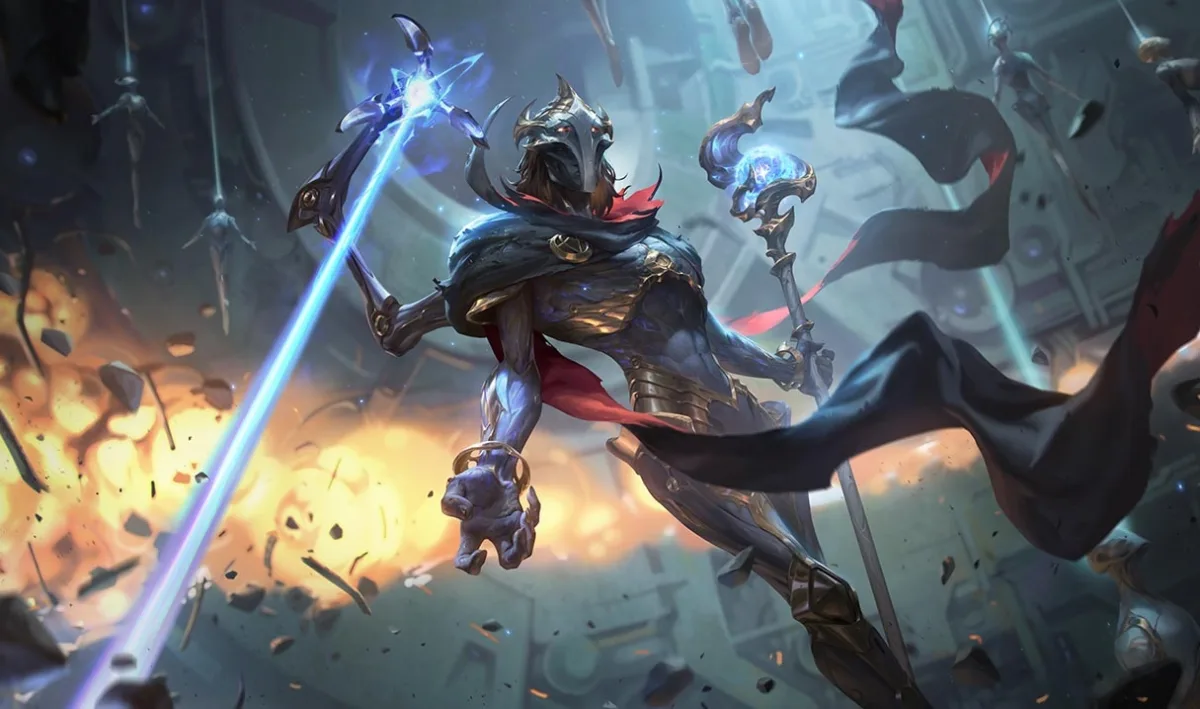
Viktor’s upgrades help him clear the wave and leave to help his team, well before level 16. His current passive grants one Hex Fragment per ordinary minion kill, 10 per cannon kill, and 20 per champion takedown. Every 100 grants an upgrade. All three basic abilities must be upgraded before another 100 can upgrade R. There is no old Hex Core item to purchase for these evolutions. These are his normal Glorious Evolution rules.
The first upgrade is a practical choice. When wave clearance is keeping you trapped, upgraded E adds an aftershock to Hextech Ray. Aim the line through the minions you need to remove, and account for the second hit rather than throwing another expensive spell immediately. The aftershock gives you another source of wave damage, but whether it finishes a specific wave still depends on your levels, AP, and the minions’ health.
Use that extra wave damage to buy time to leave lane. Clear the incoming wave, check which side your jungler controls, and look to move while the enemy mid has minions to answer. Twenty fragments from a takedown are attractive. They are less tempting when the chase leads through darkness and a cannon wave is dying behind you. Take the supported nearby play, not every possible assist.
The later upgrades solve different problems. Q adds movement speed to help Viktor maintain distance after casting. W’s upgrade lets his abilities slow, while Gravity Field itself punishes enemies who remain inside. These tools help him take another spell rotation instead of spending the whole fight running away.
The ultimate upgrade arrives after the three basic upgrades, not alongside the first one. An upgraded Arcane Storm can grow and last longer when an enemy champion it has damaged dies. Place it where an enemy is actually being held and move it as the fight shifts. Casting onto a fleeing target far away from Viktor is less promising: his storm moves more slowly the farther it gets from him.
He fits teams that can fight around a doorway, tower approach, or objective entrance. He is less appealing when the only realistic fight asks him to follow a fast diver deep into the backline. The bigger storm still needs enemies within reach of it.
Veigar: keep the cage relevant as the AP climbs

Veigar’s permanent AP comes from ability hits on champions, champion takedowns, and Q kills. Q can hit the first two enemies in its path. In the current normal rules, a Q kill on an ordinary minion gives one passive stack, while a large minion such as a cannon gives three. Every stack adds one AP, and every 50 stacks gives Dark Matter another cooldown reduction. His current passive and Q bindings matter here; older cannon-stack advice can be wrong.
Start with a farming task you can repeat: line up two low-health minions for one Q when the enemy cannot punish the angle. The cannon reward deserves attention, but a cannon behind two other minions will not be hit by that cast. Prepare its health and find a line with no more than one enemy in front of it.
If a large wave is about to trap you at low health, spend W to thin it even though those kills do not earn Q last-hit stacks. Holding W while waiting for perfect Q kills can leave enough enemy minions alive to support a dive. Clear what you must and collect the next wave alive.
In the mid game, let your cage decide which fights you can reach. Event Horizon stuns enemies who cross its edge; placing someone inside does not instantly stun them. Put the edge across an escape route or keep it between yourself and a diver. Then aim W where their movement is restricted. Dropping every damage spell into the middle of an otherwise roomy cage asks the opponent to stand still voluntarily.
Suppose a durable enemy is the only target within reach while their carry stays behind them. Help your team control and damage that front target, then keep enough space for another rotation. As the 50-stack milestones shorten W’s cooldown, watch for a second cast instead of assuming your work ends after one combo. Saving every spell for the carry can leave Veigar watching a fight he has enough AP to influence.
If your allies can funnel opponents toward the cage, Veigar has a clear job. A draft built around chasing across open ground leaves him further behind the action. Repeated flanks are another reason to pick a mid laner with an escape instead.
Aurelion Sol needs somewhere to keep breathing

Stardust improves several parts of Aurelion Sol’s kit at once: Q’s percentage-health burst, W’s travel distance, E’s area and execute threshold, and R’s impact area. That combination lets a protected Aurelion Sol threaten both a frontline and the space behind it. It does not remove the need to keep an enemy in the breath. The burst needs a full second of Q on the same target and deals magic damage, not true damage. See his current normal abilities.
Singularity earns Stardust when enemies die inside it; E need not deliver the killing blow. Place it so the minions will still be inside when they die, then last-hit for gold. Under a tower, a tower kill can still contribute Stardust inside E. You still lose the missed last-hit gold. That distinction gives you a way to preserve some progress when a tower shot beats your attack to the minion.
Against an opponent who can interrupt Q, wait for that threat to be used or get an ally between you and it. Starting a long breath in the middle of lane just because E caught the wave offers the opponent a stationary target. You can stop the channel and preserve your health rather than insist on finishing every second of damage.
Patch 26.17 reduced Q’s mana cost and improved W’s cooldown after rank one. Riot also specifically describes W as the typically stronger second max. That supports learning how to use flight, not treating it only as transport between waves. Plan a line along the fight that leaves a safe landing area, rather than flying straight through the enemy team for a longer breath. You can end flight early if the line becomes unsafe.
Before an objective, look at the ultimate’s empowered meter as well as your total Stardust. Collecting 75 Stardust toward that meter empowers the next R into The Skies Descend; it is not a permanent conversion of every future cast. Tell your team whether you have the larger knockup or the normal stun version available. Those are different openings.
He belongs behind allies who can hold an approach long enough for breath and area damage to work. Do not choose him expecting his enlarged E to solve every objective contest on its own: epic monsters cannot be executed by Singularity, and a larger zone does not prevent an enemy from reaching and interrupting him.
Smolder’s counter changes the next wave, not just the endgame

Smolder earns Dragon Practice through ability hits on champions and enemies killed with Q. His main milestones are explicit: 25 stacks add damage around Q’s target, 125 add explosions beyond it, and 225 add a true-damage burn with an execute for enemy champions who fall below its threshold while burning. Those are Q upgrades, not a claim that all his attacks suddenly burn or execute. The thresholds and damage types are in his current Super Scorcher Breath records.
Before the area upgrades, prepare Q last hits without walking into an enemy’s ready engage. A champion hit can earn progress, but trading half your health for one stack may deny the next several minions. Use a safe spell hit when the opponent steps forward; do not chase their retreat just because a counter rewards contact.
At 25 and 125, revisit how your Q changes the wave. The added area damage can make collection easier, but it can also damage minions you meant to keep alive. If you need the wave to stay near your side, watch the surrounding minions before firing into the middle of it. If you can safely push and recall, those same upgrades help create the opening.
At 225, the useful fight is usually one in which you can keep reaching an enemy with Q. A frontline target can carry the burn while your allies work on the same fight; there is no need to fly past that target to prove you can reach the opposing carry. Hold E for a change in danger. It can cross terrain, but it does not make Smolder invulnerable or guarantee a safe landing.
Smolder offers an AD-oriented alternative to another conventional AP mage, though his kit includes magic damage and eventually Q’s true damage. He is not a pure physical-damage solution, and he does not supply the hard crowd control the other stackers can bring. Choose him when the team already has ways to start fights and protect repeated casts. Decline him when those jobs are all still missing.
Check the inventory before calling the spike
Your passive counter can be ready while your inventory is not. A completed item can also have progress of its own left to earn.
If your build uses Archangel’s Staff, check its Manaflow progress before counting on Seraph’s Embrace. The transformation requires 360 bonus mana earned through Manaflow, not 360 total mana on the champion. Until it transforms, an aggressive trade cannot rely on Seraph’s Lifeline shield. This is an inventory check for that build, not a recommendation to put Archangel’s on all six champions. Riot’s current item data separates the staff from its transformation.
The same discipline applies to levels and passive stacks. Kayle can reach 16 with less item damage than the enemy carry. Smolder can reach 225 while his team has no vision outside its base. Those milestones still matter, but the next move must fit the game that produced them.
When a side wave is arriving and an objective fight is forming, decide before walking toward either. At 97 Hex Fragments, Viktor can finish an upgrade with three ordinary minion kills. If those minions are safe to collect and the fight has not started, that is a specific reason to take the wave. If teammates are already being engaged on, the same detour may make you late. Check the route and bring the tools you have: Veigar already has the cage; Viktor already has the basic storm. They can help while your teammates are still there to use them.